Do you ever feel moments of emotional tingles, when something brings on a reaction so intense it causes tiny shivers on the skin? I do. Here are a few of my tingle inducers—the grand finale of Dvorak’s New World Symphony, the view from a mountaintop in the Anza-Borrego Desert, the opening line of du Maurier’s novel, Rebecca: “Last night I dreamt I went to Manderley again.”
Recently I found a new emotional tingle in the concept of thin places—places or moments when the border between the physical and spiritual worlds feels especially thin and the divine takes on an extraordinary intimacy. Some call them portals to the sacred, where one could be, well, if not face-to-face with God, no more than a heartbeat away.
Most articles about what we call thin places agree they originated in the region of today’s Ireland, Scotland, and Wales, during the time of the early Christian church. Elements of indigenous Celtic culture blended with Roman Christianity to produce a spirituality emphasizing monastic communities, missionary journeys, and a belief that God’s presence could be found in all creation. However, some places made it easier to feel God’s presence, as if the roadblocks between heaven and earth had been removed. The thin places.
Perhaps the most iconic of thin places are found in the Celtic regions of Britain and Ireland, in sixth-century Christian monasteries that became the sites for pilgrimages and seats of spiritual learning and still exist today, such as the Iona Abbey on Iona Island in the Hebrides off Scotland or the settlement at Glendalough in eastern Ireland. Internationally recognized sacred places include Mount Sinai in Egypt; the city of Varanasi along the Ganges River in India; and Machu Picchu in Peru.
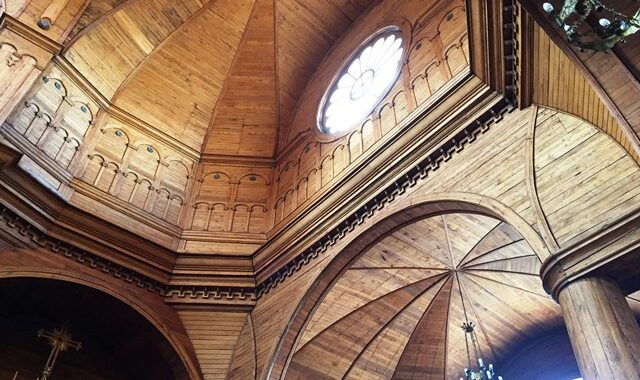
When I think of thin places, right away I think of houses of worship I’ve visited over the years, from the enormous cathedrals in Europe to the amazing wooden churches on Chiloé Island in Chile.
On a more personal level, I think of two sites where I got such a feeling, and they both involved fog. The first occurred on a retreat in New Jersey when I was a middle schooler. I sat at the edge of a lake at dawn. The water was mirror-still, and the fog hadn’t yet lifted. Ghostly white, it hovered atop the water and fingered into the silent woods. To this day, when I think of peace, I think of that mystical fog-shrouded lake at dawn.
As for the second, when I lived in Puerto Rico I often visited its lush rainforests. Most visitors to the forests’ highest peaks wanted views across the mountain slopes, down to the coast, and out to sea. But I felt a great awe in the moments when the fog moved in, erasing the world below, erasing all but the nearest gnarled moss-laden branches and the delicate ferns arcing across the paths. It seemed anything could happen when the fog moved in . . . even an encounter with the divine.
[photo Iglesia San Francisco de Castro, Chiloé Island, Chile]