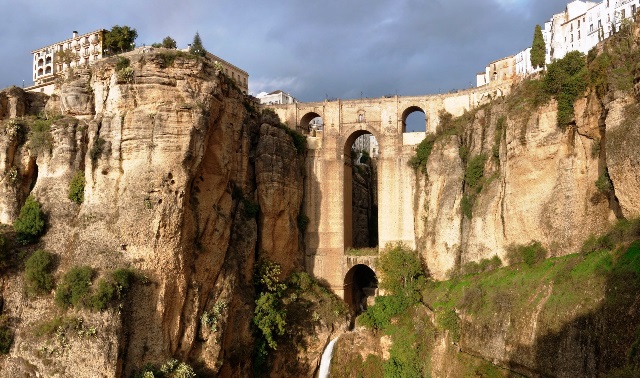
2020 is the year my husband and I have planned to take a trip to Europe and spend time in Spain, which I haven’t visited since my junior-year-abroad in college. Of course, we all know about best-laid plans in the time of the coronavirus. Though there’s no way to know when my body will get to Spain, I can do a bit of virtual traveling. Scrolling around the Internet, I zeroed in on the small city of Ronda as a fine place to visit.

Ronda [Urlaubsguru]
At home in the eagles’ nest:
Ronda perches atop craggy cliffs surrounded by mountains in Spain’s southern Andalusian region. White-washed buildings with red tile roofs and black grillwork cluster together on both sides of a 400-foot-deep gorge known as El Tajo. South of the gorge sits Ronda’s Old Quarter, where some of the cobblestoned streets are so narrow cars cannot pass. Far below, on the gorge floor, flows the Río Guadalevín.
Getting there:
Isolated on its hilltop perch, the city connects with the coast along the dramatic Ronda-Marbella Road. A winding, sometimes dangerous series of hairpin curves opens onto breathtaking views of rolling hills, olive orchards, and snow-topped mountain ranges. From Algeciras on Spain’s southernmost tip, passengers can board Mr. Henderson’s railway. Built by the British in the 1890s to connect Gibraltar with Madrid and points beyond, the train today passes through lovely rural landscapes on its way to Ronda.
Outpost or crossroads?

Santa Maria la Mayor [Wikimedia commons]
Lodging in style:

Puente Nuevo [Wikimedia Commons]
Palaces:
The Casa del Rey Moro is a palatial building that, in spite of its illusion to a Moorish king, was actually built in the 1700s, long after the Moors were expelled; its Moorish-styled gardens were added in the early 1900s. The Moors did build the Water Mine below the palace to collect water from the river below. Some 300 cliff-carved steps lead down to a lovely river pool, and adventurous tourists with good knees can follow in the footsteps of the water-collectors. The nearby Mondragon Palace, a local history museum, does date back to Moorish times.
A bullring:

Plaza de Toros, Ronda [PickPik]
There’s more:
Most of my virtual visit to Ronda took place at two websites. A delightful in-depth history of the city can be found at Andalucia.com. And Ronda Today is fun in many ways.
Great virtual tour! Add Cadaques to your list (a small village on the coast between Barcelona and France).
I shall! I’m also intrigued by the complexities of Gibraltar, although a Spanish friend here said he’d defriend me if I went there . . .