Author’s note: To most appreciate this story, first read the previous blog about the place. Thanks!
The professor and his wife, both aficionados of an old-world Spain, drove along the Route of the Pueblos Blancos. They had already been to several of the towns and were disappointed with the contemporary elements that marred the ancient alleyways—cars parked in every nook and cranny, restaurants and dance shows catering to tourists, shops featuring poorly-made souvenirs. Surely there was a village that hadn’t changed since medieval times, or, at the least, in a hundred years. Frustrated by their lack of success, they drove onto ever-narrower two-lane roads, then one-lane roads, then pitted, unpaved lanes.
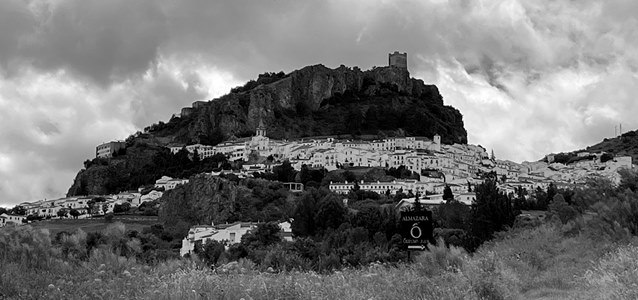
At the end of one of these, their efforts reaped reward. Half-hidden in the mountainous terrain, a hill, its shape resembling a half-melted ice cream cone, poked into the radiant blue sky. A cluster of homes hugged the lower slopes of the hill. The professor’s wife scoured their map. “I don’t see any town listed here,” she said. Most of the hillside homes reflected the dull white of fading whitewash; a few had been left as bare stone. None had the sheen of modern-day paint.
They left their car by the side of the lane and began to walk. In the air-conditioned car, they hadn’t realized the intensity of the Andalusian sun. Almost immediately, sweat coalesced on their faces, and their shirts clung to them. But their spirits remained high. The professor grasped his wife’s hand. “This looks promising,” he told her. They smiled in eager anticipation: Perhaps they’d found their medieval town.
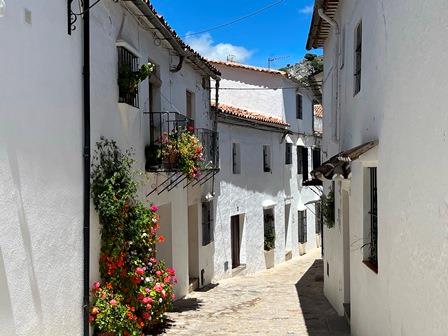
A crumbling wall encircled the village, opening up on a single lane. Beyond, most of the homes were two-stories tall, with well-worn wrought-iron balconies brightened by flower pots on the upper floors. All had seen better days. The lanes were paved with cobblestones, making walking difficult.
The wife placed a hand on her stomach. “I’m getting hungry. Let’s see if we can find a café where we can get a coffee and perhaps a pastry or an empanada.”
They wandered through a maze of narrow streets, moving ever deeper into the village. Even in the houses’ shadows, the intense heat roasted them. The interior of one of the whitewashed homes would offer modest relief from the heat, but they found no café, no bakery, no stores of any sort. Nothing was open.
The wife stopped. “There aren’t any cars here,” she pointed out.
“Thank goodness.” As fast as the professor’s smile appeared, it vanished. He tilted his head. “We haven’t seen any people, either.”
Struck by this realization, they began to peek into windows and doors covered by wrought-iron bars. The darkened rooms had furniture and paintings or tapestries on the walls, but no people.
“It’s like a ghost town,” the wife commented. She tightened the grip on her purse.
The professor took out a bandanna and sopped up sweat on his face and neck. In mid-sop, he paused, scarcely daring to breathe. “Perhaps there was an epidemic, some sort of plague that wiped out the entire town.”
With a stricken look, the wife pulled on his arm. “Let’s get out of here.”
At that moment, a movement caught their eyes. A small man wearing long shorts, espadrilles, and a cotton shirt crossed the alley in front of them. Carrying a large bag, he walked toward where the village rounded the far side of the hill. In spite of the heat, he walked briskly and didn’t seem to notice them.
For some reason, they felt uncomfortable shouting to the man. He could be a thief, or the lone survivor of the plague. Instead, they followed him, keeping a safe distance behind. Suddenly, he disappeared down the maze of alleyways. They quickened their pace. The street they were on curved to the right at the edge of the village. On reaching the curve, they stopped. Their hands flew to their faces.
In front of them, a vast landscape of wheat fields and olive orchards on rolling terrain rose into a ring of ragged mountains in the hazy distance. At the bottom of the hill where they stood, in a narrow valley, a concrete dam had formed a large lake that resembled a gray-green amoeba as it fingered into the hills. A path led from the village to a lakeside beach where the man with the bag was headed. What seemed to be the entire town stood in the water up to their knees, waists, or necks, and a few swam beyond them. Brightly colored towels adorned the sand, and dozens of cars paralleled an unpaved lane. A food truck was doing a brisk business selling aluminum cans of cold drinks and polyethyline bags of snacks. A boom box played reggaeton music.
The professor and his wife looked at each other. “I am thirsty,” the wife admitted. The professor shrugged, and they made their way down to the lake.