Though spring is gone and summer now over, for some reason my thoughts turn to springs, those remarkable eruptions of water from subterranean depths. They come in all sizes, from trickles no bigger than water in a drinking fountain to wild and powerful torrents. The largest spring in the U.S. is the prosaically named Big Spring in Missouri, though Florida and Idaho also have contenders.

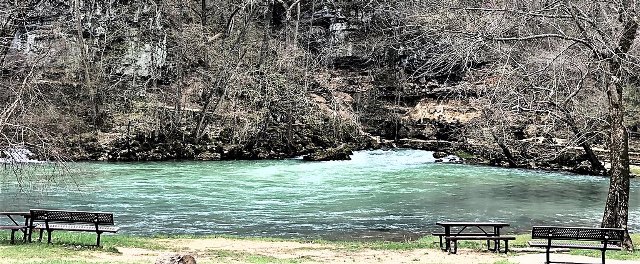
Big Spring, courtesy Johnston9494
Of aquifers and pressure:
Groundwater from millennia of rainfall and snow accumulation have seeped into the porous limestone of the Missouri Ozarks, super-saturating it to form aquifers. These vast underground water collections exist in darkness, inhabited solely by unicellular organisms and pale eyeless creatures—depleted by droughts and human use, replenished by precipitation. Pressure builds up and forces the aquifer water through a tunnel at the base of a bluff, where it bursts through to the Earth’s surface as Big Spring.
How big is big?
Though the amount of water flowing from Big Spring fluctuates with the whims of man and nature, the average daily flow is 286 million gallons, more than 3,000 gallons per second. The water travels through underground passages from as far away as 45 miles. Along with the water comes dissolved limestone, some 70 tons of it every day. Which means the water is continually enlarging an impressive cave system as it journeys toward the dazzling light of day.
Recreational opportunities:

Big Spring cabin, courtesy NPS
Located in southeastern Missouri, Big Spring is part of the Ozark National Scenic Riverways, the first national park area to protect a river system. In addition to viewing the site where the spring originates on its way to merge with the Current River, the locale features paths and hiking trails, spacious picnic areas, a campground, and the historic Big Spring Lodge and Cabins. Currently closed for restoration, the lodge and cabins were built of local materials—rough-cut limestone blocks and dark-brown stained timber—and feature the Depression Era style of architecture. They and other recreational projects in the park, from roads to trails and the campground, were constructed in the 1930s by CCC workers—unemployed, unmarried young men who voluntarily became part of the Federal government’s public work relief program.
The other spring contenders:

Silver Springs, courtesy Jackdude101
According to the park website, more-or-less equal flows gush out of Silver Springs in Florida and the Thousand Springs Complex in Idaho. Located in north-central Florida, Silver Springs State Park has a Disneyesque quality to it – ‘world-famous’ glass-bottomed touring boats, kayak rentals, gardens, a museum and gift shop, and restaurants. It also looks hauntingly beautiful, with a meandering sapphire-blue river and trails through sandhill forest of grasses, palms, and longleaf pines.
The Thousand Springs State Park along the Snake River in southern Idaho consists of several separate units of distinct natural beauty — gorges and islands, historic structures and trails. Only two of the units seem to have major springs – Niagara Springs and Crystal Springs in one and Box Canyon Springs in another. Niagara seems to be the largest, plunging down a canyon wall at 250 cubic feet (1,870 gallons) per second, not nearly the flow of Big Spring. Do we add the flow of all the thousand springs to equal Big Spring? It’s not clear.
In short, I’ll stick with Big Spring as the winner.