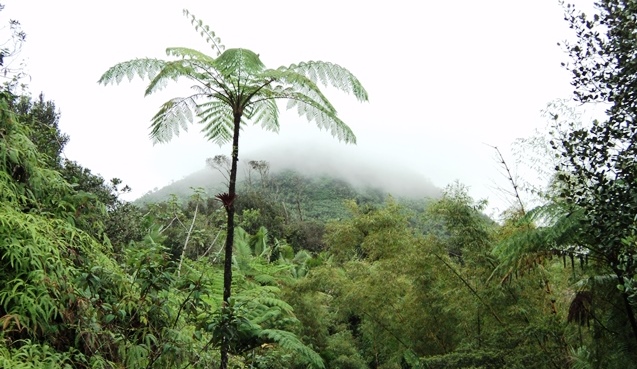
For much of its long gestation, my upcoming novel went by the title The Irony of Tree Ferns, a title appreciated by me and perhaps one other person. Most people found it confusing.
There was a reason for that title. In the book, Javi Montañez explains it to Pamela Palmer while they’re hiking in Puerto Rico’s El Yunque rainforest. They stand in front of a grouping of trees that look like tall green parasols.
“Ironic, isn’t it?” he says. “The most popular tree in El Yunque isn’t a tree at all, but a fern.” He gently pulls on a frond, releasing droplets of water. “Helecho gigante, scientifically known as Cyathea arborea, one of half a dozen species of tree ferns in the forest.”
That is one of numerous ironies in the book, which was a reason why, to me, the original title seemed fitting.
There’s also another reason for the title: I love tree ferns, and I’m glad the chosen title, Under the Tree Ferns, retains the image of that overgrown miracle of life.
Undoubtedly, Javi read about tree ferns in my nonfiction book, Where Dwarfs Reign: A Tropical Rain Forest in Puerto Rico. [He is, after all, my creation.] This is what I wrote about them in a chapter on the forest’s tropical greenery:
In an ironical touch that is nevertheless typical of the complex tropics, one of the most beloved plants in El Yunque is actually thought to be a tree. It is an outsized member of the class Filicinae, commonly known as the tree fern. These delicate parasols stand out like stilt walkers in sunny patches of forest and cling together like demure belles in protected portions of the upper mountains. Though tree fern trunks can grow well over 30 feet high, they are not “normal.” Unlike most tree trunks, they do not expand as they grow; instead, they remain slender poles that rarely exceed five inches in diameter. The trunks are actually bundles of exceptionally elongated roots held together with pith and contained within a dark and scaly outer layer that is often decked with mosses, liverworts, and smaller ferns. Though spindly, the trunks are sturdy and long-lasting, and older mountain residents remember once using them to build homes. Carib Indians apparently used them to transport fire, which could somehow be kept within the trunk for hours without causing flame or smoke. A dozen or more fronds flop over the top of the trunks. Starting as tightly coiled fists, these elegant fronds unroll into majestic quills up to 12 feet long.
There are several species of tree-sized ferns in the Luquillo Mountains. The most common, Cyathea arborea, grows abundantly along Luquillo roads. Its trunk is spineless; a spiny relative found deep within the forest is the bane of cross-country hikers, who grab it for support—once. Ferns can be found most everywhere on the planet, but tree ferns have developed solely in moist tropical areas where their roots can be continually pampered in warm, water-logged, clayey soil.
Though common residents of El Yunque, tree ferns, to me, are far more suited to the enchanted forests of fairy tales. Perhaps that is yet another of their ironies.
[photo El Yunque National Forest]