‘Clear Lake’ is a descriptive if somewhat overused name for bodies of water large and small. In Washington alone, a quick search on the Internet turns up three Clear Lakes and one Clear Lake reservoir; in Oregon, there is a Clear Lake and a Clear Lake reservoir; only in California did I find no competition. My ‘personal’ Clear Lake here in Spokane County, WA is spring-fed and covers 350 acres. It has a slender body set between forest and stubby cliffs, and a shallow fringe of hidden ponds and channels. Shelter for all kinds of birds and even a moose or two, it is often the place I go for my first kayak outing in the spring.
On a recent road trip from Spokane to southern California, I added two more Clear Lakes to my personal list. One of them tantalized from afar, the other mystified up close.

Clear Lake, Spokane County, WA
Clear Lake, Willamette National Forest, Oregon:

Three Sisters Mountains, OR
The Clear Lake here proved to be a victim of the road not taken. On our drive home from southern California, we left the southern Oregon coast at Florence, and, after passing through Eugene, followed the McKenzie River east. In spite of recent forest fires, the drive was spectacularly beautiful. Beyond the community of McKenzie Bridge, we had to make a decision—curve north along Route 126 or take the more rugged McKenzie Pass–Santiem Pass Scenic Byway, closed in winter. We chose the latter, and with its eye-popping vistas, snow-capped mountains, lava fields, old-growth forests, and a curious observatory built of lava rock, didn’t regret our choice.

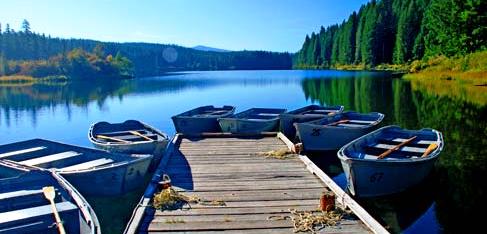
Clear Lake, OR. Photo by Gary Halvorson, Oregon State University.
The other way, along 126, would have led us past Clear Lake. Nestled in Oregon’s High Cascades, this is a small (142 acres) gemlike mountain lake and the source of the McKenzie River. Lava from a volcanic eruption some 3,000 years ago dammed it naturally and, in the process, submerged existing forest under 120 feet of water. Remnants of those underwater trees still exist. Fed by a stream and filtered through lava rocks, the water here is crystal clear and strikingly blue. With visibility up to 200 feet and a white volcanic silt bottom, Clear Lake is a paradise for wet-suited scuba divers; however, with average water temperatures scarcely above 40 degrees F, it is not so enticing to swimmers. I hope to return one day. However, to paraphrase Robert Frost, way does lead on to way, and there’s a good chance I may never get back.
Clear Lake, Lake County, California

Redwood National Park, CA
On our drive down to southern California, we followed Oregon’s southern coast and California’s northern counterpart, spending an hour or so amid the giant trees of Redwood National Park, then headed inland along a patchwork journey toward San Francisco Bay. Looming large on the map ahead of us was an impressive body of water known as Clear Lake. As car navigator, I chose a northern route around the lake to give us close-up views. Descending a bend in the road, the lake appeared as a vast body of water shimmering a faded ghostly blue. Surrounded by semi-arid mountains, it should have beckoned us, an oasis on the landscape, but something seemed off. Modest homes and trailer parks lined the banks of the lake cheek by jowl, but we didn’t see families romping along the shoreline or boats skimming the water. The lake seemed full yet numerous rundown wooden docks extended like diving boards eight to ten feet above the surface. We didn’t stop; I didn’t take photos. Was there a prettier side of the lake along a different road? Perhaps the docks were fishing piers? Was this a reservoir, another victim of the region’s severe drought? Later, I did some research.

Clear Lake, CA. Photo by Federico Pizano, Panoramio.
Clear Lake is not a reservoir; it is a natural freshwater lake. At almost 44,000 acres, nineteen by eight miles at its widest, this is actually the largest freshwater lake entirely within California (Lake Tahoe is partly in Nevada), set amid some of the cleanest air in the nation. What’s more, its existence dates back two and a half million years, making it the oldest lake in North America, with volcanic remnants on the south side. It is quite shallow, with an average depth of twenty-seven feet, and warm in summer. Largemouth bass abound along with other fish, waterfowl, and animals that inhabit the nearby hills. Native American tribes have lived along Clear Lake for more than ten thousand years and, against historic odds, continue to celebrate their cultural ties to the lake. It has long been known as a popular place for watersports, with resorts, marinas and watercraft of all sorts, skiing, sailing, fishing, kayaking, and swimming, and today several wineries sprawl across the surrounding hillsides.
However, something is wrong, the age-old tale of too much human interference. At one time, wetlands rich with tule reeds surrounded the lake, filtering the water and keeping it clear; as of today, eighty-five percent of the wetlands have been destroyed. Native hatch once spawned here in the millions; now, in the mere thousands. Invasive aquatic plants and mussels proliferate. Algae blooms, including toxic cyanobacteria, have always existed in the shallow waters but never in the abundance seen today. All of this is due to a complex variety of factors—deforestation, construction, fertilizers, wastewater discharge, seepage from a local mercury mine. One human interference popularized in Rachel Carson’s book, The Silent Spring, dealt with the Clear Lake gnat, a non-biting insect so prevalent it made life miserable for humans. The pesticide DDD was applied to control the gnat population, and it in turn contaminated the eco-system and decimated waterfowl populations.
And on and on.
There is hope. We now have a much better understanding of ecology, and projects are underway to counter some of the negative effects on Clear Lake, with modest success. May the work continue.