[Author’s note: Two years ago, I planned to take this blog from one of the coldest places on Earth to one of the hottest. I completed the coldest, Oymyakon settlement in Russia, and started the hottest, Death Valley in California. However, something—perhaps it was the word “death” in the title or life with all its demands—conspired against me. At long last I’ve returned to the second blog. Here it is, with my promise that this will be the first of more places and the stories about them.]
A vast low-lying basin in southern California resembles lunar terrain—stark, lifeless, and baked by a scorching sun. Acknowledged as the hottest place on Earth in summer months, it can kill an unprotected human in a matter of hours. A group of prospectors found this out when they attempted a short-cut to California’s gold mining camps in 1849. Thirteen of them perished in the heat, giving rise to the basin’s name—Death Valley.

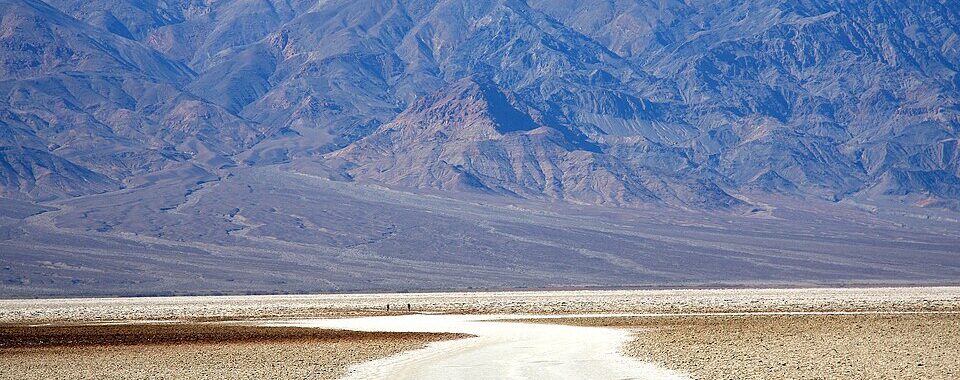
Badwater Salt Flats
Photo by Photographersnature/Creative Commons.
A Terrain of Extremes:

Mesquite Flats. Photo by Tuxyso/Creative Commons.
Over 150 miles long, Death Valley slumps between two ranges—the Amargosa to the east and Panamint to the west. During the time of mountain building hundreds of millions of years ago, underlying tectonic plates shifted. In the western U.S., land folded, rose, and erupted. Eventually—a mere three million years ago—the region pulled apart, taking on its present-day form. Snow-capped peaks in the Panamints, the highest over 11,000 feet, border Badwater Basin, the lowest point in the U.S. at 282 feet below sea level. In the basin, temperatures have topped 130 degrees F., and annual precipitation averages a scant two inches. The vast landscape encompasses salt flats, sand dunes, narrow twisting canyons, dry river beds, and even an oasis or two. The Death Valley National Monument, established in 1933, became a National Park in 1994. https://www.nps.gov/deva/index.htm At almost two and a half million acres, it is the largest national park in the continental U.S.
Hunters, Miners, and Mules:

Ryolite Caboose. Photo by Finetooth/Creative Commons.
Death Valley’s earliest inhabitants, the Timbisha Shoshone, have lived here for centuries, traditionally hunting desert animals, harvesting piñon nuts, mesquite beans, and whatever else the desiccated land might provide, and retreating to the mountains in the hottest months. The Gold Rush in 1849 brought the first wave of prospectors across the valley. The discovery of borax, a white mineral found in some salt deposits, drew in workers, including Chinese, Germans, and Basques. The famous twenty mule teams transported the borax out of the valley. During the Depression, Civilian Conservation Corps workers hewed many of the thousand miles of roads that cross the valley.
Survival of the Fittest:

Wildflowers. Photo by U.S. Department of the Interior.
Wrinkled mountains rise above the flat valley, all decked out in desolate shades of beige, brown, and gray. It’s hard to imagine anything living here, but nature has adapted. Creosote bushes, desert holly, and cacti anchor onto the desert floor, and in the spring, wildflowers burst into bloom. Native animals have developed special survival mechanisms. Bighorn sheep can go several days without water, losing up to a third of their body weight. When they do find water, they drink gallons at a time to rehydrate. The cute little kangaroo rats don’t need water, surviving on seeds and dry vegetation. Tortoises spend most of the year burrowed underground, coyotes hunt by night, and jackrabbits release heat through their over-sized ears.
Things to Do:

Death Valley at Night. Photo by Dheera Venkatraman/Creative Commons.
Over a million people tour Death Valley National Park every year, and a surprising number of them brave the summer heat. By day, they walk around sand dunes at Mesquite Flats and the salt flats of Badwater Basin; drive to stunning panoramas of sun-hued mountains and sizzling desert floors at Zabriskie Point, Dante’s View, and Artists Palette; explore old ghost towns, mines, borax works, and charcoal kilns; all while wearing wide-brimmed hats and guzzling lots of water, if they’re smart. By night, they set up at the popular National Park campgrounds or splurge a bit at the Inn at Death Valley, earlier known more starkly as Furnace Creek Inn. Wherever they are, they look up in mesmerized awe at the stars. With some of the darkest night skies in the U.S., Death Valley has been certified as an International Dark Sky Park.
A Movable Lake:

Lake Manly. Photo by Nomdeploom/
Creative Commons.
In the summer heat, Badwater Basin shimmers like water, a mirage that has given hallucinatory hope to many a desperate desert wanderer. But in the spring of 2024, the mirage came to life as flooding from Hurricane Hilary and heavy late winter rains dumped water into the basin, creating a temporary lake some six miles long, three miles wide, and a foot deep. Kayaking in Death Valley? It was an opportunity too good to pass up, and paddlers descended en masse to crisscross the water. Shortly after, prolonged high winds moved the entire lake two miles to the north, hastening evaporation and making it even shallower. No more kayaking. Curiously, the temporary lake had a name—Lake Manly, in honor of a man who helped rescue a group of travelers stranded in Death Valley in 1849. It had existed on a much larger scale thousands of years ago, but as the climate warmed, the lake evaporated, leaving behind extensive salt flats. At last notice, the lake is still there, though now only four miles long, two miles wide, and several inches deep.