I’m returning to extreme places, this time to the lowest land point on Earth. No, the winner of this distinction isn’t California’s Death Valley. At 282 feet below sea level, Death Valley comes in a mere eighth on the list. There are lower places in such countries as Argentina, China, Egypt, and Kazakhstan. The lowest point—drum roll—is the Dead Sea, cradled in a deep valley between Israel and Jordan in the Middle East. At a fluctuating 1,355 feet below sea level, the Dead Sea is considerably lower than the runner-up, Djibouti’s Lake Assal at 509 feet.

The Jordanian side of the Dead Sea. Courtesy Gusjar, Flickr.
A lake, not a sea

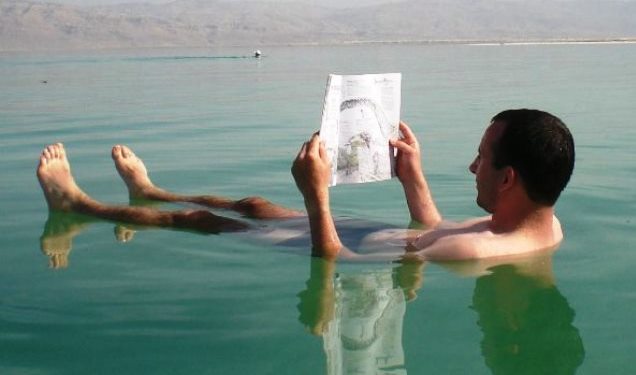
Floating on the Dead Sea. Courtesy babeltravel.
The Dead Sea, also known as the Sea of Salt, is actually a lake in the Jordan Rift Valley, ringed by stratified hills, surrounded by desert and bordered by the Judaean Mountains to the west. The use of the word ‘dead’ refers to the fact that no fish or plants can survive in the water, and the word ‘sea’ refers to its salinity. In point of fact, the Dead Sea is ten times saltier than the ocean. Three to four million years ago it was a lagoon, often flooded with water from the Mediterranean. By two million years ago, the lagoon became landlocked, and subsequent tectonic shifting lowered the valley floor. The Jordan River emptied into the lake, but it had no outflow, and, in the hot desert climate, water evaporated quickly, leaving behind salty minerals to mix with the freshwater. In recent years, the Dead Sea has shrunk due to irrigation projects and droughts. Today, it measures some thirty miles long and nine miles at its widest, with a depth up to 1,000 feet. The lake’s northern basin remains intact, but the southern basin has dried up and is little more than a series of evaporation ponds, with water pumped in from the north.
Of mud and minerals

A Dead Sea mud bath. Courtesy Chadica, Jerusalem.
Some of the salt has solidified into a whimsical collection of objects—diamond and pearl shapes, stalactites, cushions, pillars, and islets. Because of its density, the warm water provides a natural buoyancy, enabling even non-swimmers to become expert floaters. The salt and mineral content of the water and mud combined with the low-altitude, oxygen-rich air attracts both health researchers and those suffering from various ailments, including arthritis, psoriasis, rheumatism, and high blood pressure. Natural spa treatments include bathing in the water and packing mud on the skin, particularly around sore knees. Some say the region’s reduced ultraviolet rays means you can’t get sunburned, but I for one wouldn’t test that theory.
A deadly prognosis

The Israeli side of the receding Dead Sea. Courtesy Tiia Monto.
For decades, the Dead Sea has been shrinking. Water has long been diverted from the Jordan River for irrigation in Syria, Jordan, and Israel, and by the late 1960s, the Jordan River no longer emptied into the lake. Adding to the crisis are years of low rainfall. Today, the Dead Sea is half the size it was a century ago, and it drops on average an additional three feet every year. Thousands of treacherous sinkholes have opened up along the receding shoreline, historic resorts now lie in ruins far from the water, and water for many of the newer resorts must be piped in. An ambitious project to channel water from the Red Sea to stabilize the recession remains in proposal stage. Experts predict that, if nothing is done, the Dead Sea could disappear in forty years.
Still the tourists come

Ein Gedi Beach on the Dead Sea. Courtesy “Myself.”
In Biblical times, King David sought refuge near the Dead Sea, Lot’s wife turned into a pillar of salt in neighboring Sodom, and King Herod and Cleopatra vacationed here for their health. The Egyptians used the lake’s asphalt for mummification, and its potash has long been excavated for fertilizer. The Dead Sea remains a major tourism destination. There are small communities, hotels, spas, and public beaches along the lake in both Israel and Jordan, with tours and shuttles from Jerusalem. During the winter months, tourist groups from colder climates descend, and summer months tend to draw the locals. For a more restful experience, off-season months are recommended. On the Israeli side, nearby attractions include Qumran National Park, where the Dead Sea Scrolls were found by a shepherd in a cave; the Masada, an ancient mountaintop fortification; and Ein Gedi National Park, site of lovely springs and hiking trails. On the Jordanian side, the breathtaking rock-cut architecture of Petra lies some one hundred miles to the south.
For more information, visit https://deadsea.com/