“In fourteen hundred ninety two, Columbus sailed the ocean blue.” Other things happened on the Iberian Peninsula that year under the reign of the Catholic monarchs, Queen Isabella and King Ferdinand. The Kingdom of Granada, last Muslim stronghold in Spain, fell, ending centuries of Islamic rule. Shortly afterwards, a decree ordered Jews who did not convert to Christianity to be expelled. These changes affected all of Spain, but particularly the southern region of Andalusia, and, even more so, a string of frontier villages known today as the Pueblos Blancos (white towns) of Andalusia.
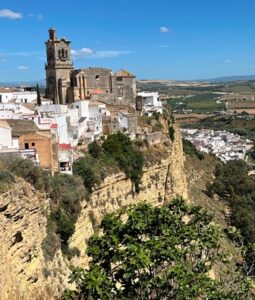
Arcos de la Frontera
A Bit of History:
Southern Spain’s location on the Mediterranean has led to a rich mix of settlers and invaders. An early succession of marauding tribes crisscrossed the region, followed by the Romans, Visogoths, and Muslims. Their reigns were rarely peaceful, particularly during the Reconquista, when the Christian monarchs sought to reclaim the peninsula from Islamic rule. The southern plains became vulnerable to attacks. Andalusians built fortified villages in the mountains, where they could gain a strategic advantage, better protect themselves, and control trade routes.
Awash in White:
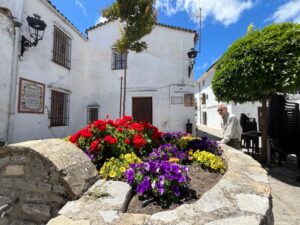
Grazalema
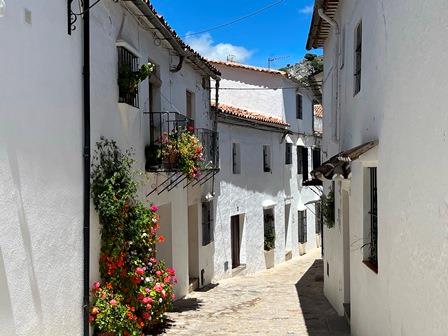
From a distance, these villages appear to be impossible. Homes and churches are built virtually atop each other on hills: they seem to cling for dear life to the steep slopes. And most homes are painted a white so brilliant it gleams in the intense sunlight. Traditionally, the white resulted from layers upon layers of whitewash, a procedure in which cal (lime that has been hydrated), is mixed with water to form a paste. Whitewashing kept homes cool during the hot summers and aided in disinfecting and sanitizing them during times of plagues and other epidemics. Today, many residents continue the tradition, often using industrial paint rather than whitewash. The white walls make a pleasing contrast against the red tile roofs, blue sky, and taupe landscape.
The Route:
Our base town of Arcos de la Frontera resembles a white hide flung across a mile-long ridge that is pinched in the center. Arcos is the largest of the numerous white villages strung together along a triangular route of some 125 miles. (On the eastern end is Ronda, which I viewed virtually during the pandemic—you can visit it through this blog.) Known as the Route of the White Villages, it offers stunning natural vistas, lush mountain forests, picturesque villages, colorful flora, traditional crafts and foods, and historic centers that, except for the cars, appear to stand still in time.
A Frontier Fortress on High Ground:
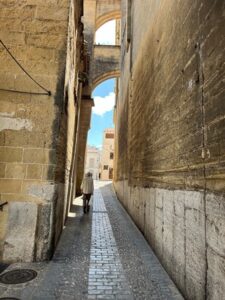
Arcos de la Frontera
Arcos de la Frontera’s name comes from the Roman word for “fortress on high ground” and the Spanish word for “frontier.” As we ascended into its historic district, the streets got narrower, steeper, and more confusing until we reached underground public parking. From there, we had to continue on foot or by taxi. Loaded with overnight gear, we opted for a taxi to reach our lodgings, the Parador de Arcos de la Frontera, a half-mile away. The ancient alleys are astonishingly narrow: side mirrors folded inward, the taxi crawled through tight spots with scarcely an inch to spare. From the parador, former home of a local magistrate, cliffs plunge over 300 feet to the plain below, offering stunning views of pastoral landscapes and the Guadalete River below. In spite of its cramped space, the town has numerous churches, convents (one still in use), fortresses, and palaces. Several churches were built on Visogoth temples and Muslim mosques. In fact, the mix of Islamic, Jewish, and Christian influences can be seen everywhere—building facades, restaurant menus, and local shops.
The Rain in Spain:
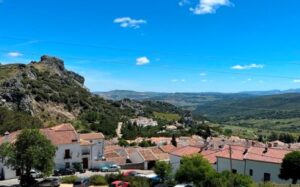
Grazalema
A curious fact—the wettest region in Spain is not in Galicia but in Andalusia, in the Sierra de Grazalema mountain range. We drove through Grazalema Natural Park on our way to the village of the same name. Though it didn’t rain that day, miles of deep-green forest blanket the mountain slopes, and moss etches gnarled tree limbs. Hiking paths crisscross the forest, but we drove straight to the village of Grazalema. Built halfway up a mountainside, it resembles a white ribbon trailing through the greenery, and this contrast makes Grazalema one of the prettiest towns in Spain. We parked our car on the outskirts and wandered down narrow winding lanes wedged between white homes, black balconies, and bright-colored flowers in pots. At a small picturesque plaza, we had lunch.
An Unexpected Gem:
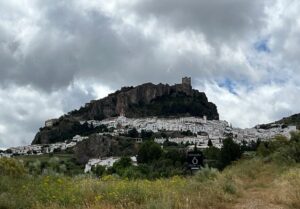
Zahara
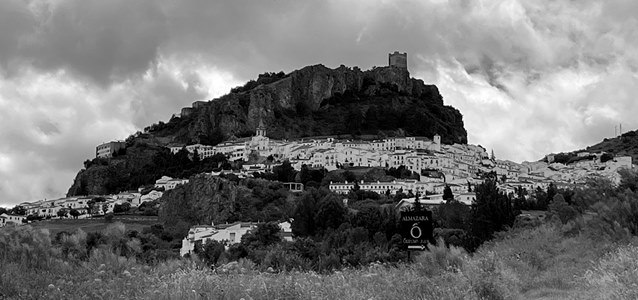
Daunted by the sprawl and upscale leather stores in the town of Ubrique, we decided to stop instead at Zahara de la Sierra. At a bend in the road, the ghostly mountain village comes into view, and the view is stunning. Whitewashed homes cram every which way on the lower slopes, and the steep upper crag is crowned by a castle/fort of Muslim origin. Parked at the base of the hill, we wandered along the village streets, ever upward, past homes and miniature plazas and small churches, upward beyond an occasional restaurant and shop, to a path that ascends to the castle ruin and dramatic views of a ring of mountains, agricultural communities, and a manmade lake.
We felt like shouting an olé to old Spain.