Three years ago, long before the current pandemic shut the border between the U.S. and Canada, my husband and I traveled to Victoria, capital of British Columbia, Canada’s westernmost province. Though modest in size—350,000 people in greater Victoria—it was western Canada’s first British town, is considered the most British of Canada’s cities, enjoys mild maritime weather, and sits at one corner of a spectacularly beautiful island.

Courtesy Brandon Godfrey, Wikipedia Commons
Getting There:

Gulf Islands
Vancouver Island, resembling a fat 300-mile-long cigar, fits like a missing puzzle piece into a hook of land that stretches from Olympic Peninsula, to the islands north of Seattle, around the city of Vancouver, and on up the Pacific coast. From our home in Spokane, WA, the car drive was a journey in itself – across the North Cascades mountain range, down to the island city of Anacortes, on a car ferry through Washington State’s beautiful San Juan Islands and Canada’s Gulf Islands to the ferry terminal on North Saanich Peninsula and, once again on highway, south to Victoria.
Of Victoria and Vancouver:

Totem
A number of indigenous communities, primarily of the Coast Salish people, settled on Vancouver Island long before the arrival of Europeans. They spoke several languages and dialects, and I imagine the island itself was known to them by several names. With the arrival of Europeans, there was eventually one name – Vancouver – for a variety of places. Why Vancouver? George Vancouver, an officer in the British Royal Navy, explored the Northwestern Pacific coast in the 1790s and wound up with his name on three sites in the region. The first was Fort Vancouver, established just north of the Columbia River in Washington State. In 1843, a fort, later known as Fort Victoria for the British queen, began as a trading post on Vancouver Island. With a gold rush in the region in the late 1850s, the fledgling outpost mushroomed into a bona fide town. When British Columbia became a province, in 1871, Victoria was named its capital. Later, the city of Vancouver was founded on the mainland.
Downtown Victoria:

Parliament
Historic Victoria wraps around Inner Harbour, making it a lovely place to explore on foot. In wandering along the harbor, we passed dozens of very British buildings of Edwardian architecture, popular in the early 1900s. Two of the most massive are the Parliament buildings and the elegant Empress hotel, where high tea is a daily ritual (in season and probably pre-pandemic); unfortunately, it was a ritual my husband didn’t care to try. Interspersed around the city’s buildings are brightly colored carved totems that reflect the First Nations heritage. The city has numerous museums, parks, galleries, shops, and restaurants, but we only had time to sample a few — a curious museum of miniatures (billed as the greatest little show on earth), several bookstores, the Craigdarroch Castle (actually, the ill-starred Victorian mansion of a coal baron), and Chinatown, which, though small, is the oldest in Canada, historic home to Chinese who came, first, in the hunt for gold, and later, to work the railroads.
Butchart Gardens:

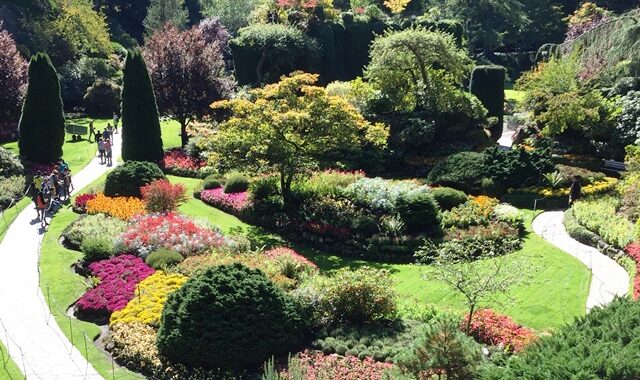
Sunken Gardens
We hadn’t even stopped in Victoria when we made a detour to Butchart Gardens, located halfway between the ferry terminal and the city proper. In 1904, the Butcharts bought land around a limestone quarry in Brentwood Bay. When production of cement from the limestone was exhausted, Jeannie Butchart envisioned transforming the site into a sunken garden. Over the decades, the gardens expanded to include not only the sunken garden but also Japanese and Italian gardens, and a rose garden. Today, Butchart is a National Historic Site, encompassing 55 acres and retaining 50 full-time gardeners. It is worth a visit any time of year. We went in early October, and the gardens were still alive with a wealth of flowering plants.
The Pacific Marine Circle Loop:

China Beach Provincial Park
Our final day we ventured out on Vancouver Island, heading southwest to the small town of Sooke and the Pacific Marine Circle Route. At Sooke, we took a short walk to a spit of beach at the gateway to the harbor. The road paralleled the Strait of Juan de Fuca (named for a Greek maritime pilot sailing for Spain who may never have reached the strait), with views across the water to the Olympic Peninsula. We stopped at China Beach Provincial Park and walked on path and steps through lovely old-growth forest of Sitka spruce, Douglas fir, and Western red-cedar before reaching a long uninhabited sweep of beach. Deep green forest on a bed of ferns, pale beige sand, deep blue ocean, and hazy green mountains across the way – it was truly a magical spot. Then we continued along the road, paralleling the well-known Juan de Fuca Marine Trail, to Port Renfrew (if it had a downtown, I missed it) and inland across the island. After passing the large Cowichan Lake, we reached Highway 1 on the north/east coast. I would have loved to have continued west to the end-of-the-line village of Port Hardy and view the island’s vast wilderness of forests, trails, and secluded beaches, but that will have to be another, post-pandemic trip.