Author’s note: To get the most out of this story, I recommend you first read the previous blog about the place. Thanks!
Peta searched for a hiding place in the mountainous terrain on the remote side of Delos. Although dressed in a tunic and cloak worn by men, her enlarged belly marked her sex—and her need to remain hidden.
If I am found, my child will be taken from me, and I will be punished, perhaps sacrificed to Apollo for defiling the place of his birth. I can’t let that happen.
Peta hailed from the island of Rhodes. As the only child of wealthy spice traders, she had lived a life of spoiled luxury. Girlish pursuits never interested her. Instead, she spent her time hunting, sailing, and participating in athletic games. Her mother wrung her hands at Peta’s rebellious nature, but her father secretly admired this in his daughter, and he chose not to rein her in. Her only friends were the boys with whom she competed. The exciting, carefree childhood ended when she played a different sort of game with a handsome rower and discovered she was pregnant. Peta knew enough not to tell her parents: her mother would use this as an excuse to imprison her inside their home. Disguised as a man, she signed on as a sailor and left the island of her birth, eager to embark on an independent life touring the world.
I am doing this for my child.
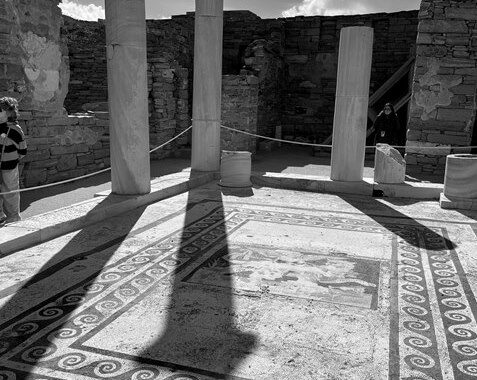
A healer at a market on a distant island offered Peta herbs to eliminate the pregnancy, but Peta refused them. Instead, she probed the woman for details about giving birth. She liked the idea of becoming a mother, and, perhaps because of her sheltered immaturity, gave little thought to what would happen after birth. On dark starlit nights, she looked at the sky and imagined grand things for her child, even as a modern-day Mount Olympian god. Apollo as the child’s father . . . why not? That would surpass mere human legitimacy. The idea thrilled her and wouldn’t let go. She made her way toward sacred Delos, intending to defy the edict that no human could be born on the tiny, rocky island where Apollo and Artemis were born. Her child would be special.
When she reached the neighboring island of Mykonos, far along in her pregnancy, Peta jumped ship. After buying supplies, she stole a fishing boat and, in darkness, sailed to Delos. For two months, she lived there, keeping away from the island’s inhabitants and supplementing her food supplies with thefts from hillside gardens. One day she spied one of her father’s spice ships entering the harbor. The sight gave her a pang of longing for her old carefree life. She shrugged: having a god-child would be worth her current depredations.
It is time.
When the cramps began, she entered a cave chosen earlier. Mindful of the market woman’s instructions, she submitted to hours of pain and pushing until a miniature boy, puckered and slick with blood and fluids, slid into the world. Two days later, she emerged from the cave with baby Theos wrapped in a blanket. The night was made darker by hovering rain clouds. She brought the baby to the temple of Apollo and stood in front of the larger-than-life marble statue.
This is your son. Bless him.
Satisfied, Peta stole another boat and made her way up the islands of the Aegean to the port of Pireaus and from there to Athens. Inventing the death of a fisherman husband during a violent storm, she became a well-known worker at the fish markets and eventually opened a stall of her own.
The years passed in modest comfort. Though Peta loved Theos dearly, she lacked a knack for parenting. Day after day, she wrung her hands as she watched her son for signs of his connection to Apollo. A handsome boy, he showed great skill as a sailor but otherwise seemed normal in every way, and, she had to admit, a bit simple in his thoughts.
When the boy turned sixteen, he disappeared. Peta’s heart ripped in two. She searched for him for days, eventually discovering he had signed onto a spice ship, bound for the Far East.
Consumed with grief, Peta found solace in wine, in ever larger portions. She stopped tending the fish stall, and lost it to an ambitious competitor. Before long, no one would hire her for even the most menial of tasks. Starvation momentarily cleared her senses. She would stow away on a boat to Rhodes and throw herself on the mercy of her parents. When she arrived, she learned her parents had died. No one spoke up for her. The current ship owners, fearful of her claims, reported her as a thief to the authorities. After spending a month in confinement, Peta was exiled to the Anatolian Peninsula.
I have been brought down.
For two years, Peta lived on Anatolia in primitive conditions. While begging for alms, she told all who came near that she and her son had been cursed by Apollo on the sacred island of Delos. Soon few came near. When a plague spread over the land, she was among the first stricken. Though she pleaded with Apollo to forgive her youthful hubris and send his son, Asclepius, to heal her, Apollo didn’t listen.
The plague took Peta, and thousands of others.
.