In October, John and I went on a Road Scholar trip to Greece, traveling on large ferries to several islands in the Aegean. (I’ll focus on this trip for several blogs.) We were submerged in archaeology and ancient history—stepping around rubble walls and rows of columns under a Mediterranean sun; viewing marble statues and painted pottery in beautiful museums; and learning of cultures that date back thousands of years. Of all the ancient Greek sites we visited, most impressive was Delos Island.

Delos.
Mykonos, Gateway to Delos:

The town of Mykonos.
Mykonos, roughly six by nine miles and horseshoe shaped, lies in the heart of the Aegean, one of the Cyclades islands. The landscape is dry, with brown scrub and occasional trees, and much of the consumed water is desalinated seawater. In summer months, Mykonos beckons party-goers with lively bars and nightclubs, upscale shops and art galleries, laidback beaches, and small villages. Visitors come in droves, up to a million annually, and Mykonos has become one of the most expensive islands in Greece. Architecture in the town of Mykonos is typical of the Aegean—white-washed boxlike houses with blue shutters and small balconies bunched on hillsides; mazes of narrow stone-paved streets; an historic Venetian quarter at water’s edge; and churches and chapels everywhere. Today, most of the houses in town have been converted into tourism shops and rentals, and Mykonians live elsewhere. When we were there, the party-goers had left, replaced by families and older crowds, but the town’s stiff year-round winds remained. Boats leave regularly from the docks for the half-hour ride to Delos Island. The day we went, the air was chilly, the winds brisk, and the sea choppy.
A Sacred Island:

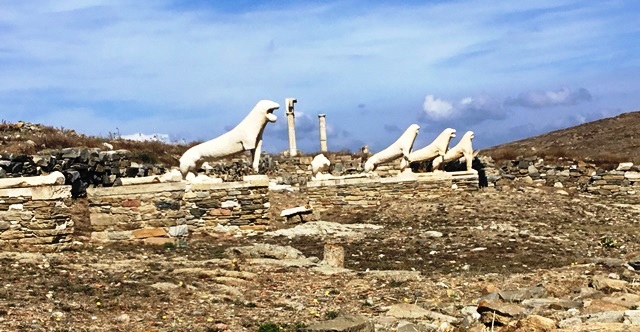
Terrace of the Lions.
Ancient Greek mythology, teeming with legends of gods and goddesses, heroes and monsters, gave a sense of meaning to Greeks of that time. Central to the mythology were the gods who lived on Mount Olympus, Greece’s highest mountain. Zeus reigned as king of the gods and father to many. According to legend, he had a mistress, Leto. Perhaps needless to say, his wife, Hera, queen of the gods, was jealous. When Leto became pregnant, Hera shunned her from all land on Earth. How then could Leto give birth? With the help of Poseiden, god of the seas, Zeus anchored a small rocky island in the Aegean—today’s Delos. Here Leto had twins, Artemis, the goddess of hunting, followed by Apollo, god of knowledge. All the gods appeared on Delos to mark Apollo’s birth, all except Hera. In the third century BC, the poet Callimachus declared Delos to be the most sacred of islands.
A Bit of History:

Mosaic floor. Courtesy John Harmon.
Inhabitants lived in stone huts on Delos as early as the third millennium BC, and the island hosted religious activities even before the Ionians, an ancient Greek tribe, introduced the worship of Apollo. In the first millennium BC, Delos became a place of festivals and pilgrimages, and the island was ‘purified’ for worship. All inhabitants, both living and buried, were removed, and no one could be born or die on the island. Wealthy Greeks built homes to be close to their gods.
Its location also made it ideal for trade. Delos became a major commercial port, its trade including slaves and spices, and Roman settlers built opulent houses and large public spaces. The town was sacked several times and trade routes changed: the population diminished, until by the eighth century AD the island was abandoned. In the nineteenth century, French archaeologists uncovered astounding ruins on the island. Today Delos is a World Heritage Site, open to the public only during the day.
Our Visit:

Amphitheater. Courtesy John Harmon.
We didn’t expect the excavations on Delos to be so vast and so well preserved; nor did we expect the cultures we visited throughout the Aegean to be so advanced. On Delos, dozens of walls, their stones meticulously set, remain from the early centuries BC. Later walls, from Roman times, made use of mortar to hold the stones in place. Our tour leader explained the layers of history as we trooped around the ruins of opulent homes, marble floors and window frames, public wells, private baths, floor mosaics, column-bordered atriums, temples, statues of gods and animals, and an amphitheater that could hold 5,000 for plays attended by men, women, and slaves. Some of the statues, such as a row of lions, are replicas, the originals protected in museums. A central sacred lake endured into the twentieth century, when it was drained to prevent the spread of malaria. Archaeologists remain on the island, continuing excavation work; well-fed cats prowl the grounds; and even in October, hordes of visitors milled about. A hill dominates the island, and views extend across deep blue water to Mykonos and other neighboring islands.
To touch walls and mosaics put in place by humans thousands of years ago–that seems a sacred act in and of itself.

Stone wall without mortar.
I would love to visit there!
Sent from my iPhone
<
div dir=”ltr”>
<
blockquote type=”cite”>
It was an amazing visit, as you’ll see in my next few blogs.
Great travelogue! You are truly a cross between Edith Hamilton and Robert Graves in this essay. After watching the film The Glass Onion, I am primed for your fictional short story for Delos.
Funny how the Greek island can look so desolate until you actually see them up close. Mary still loves retsina!
Keep the pen hot…… Richard
Thanks, Rich. Yes, the Aegean has a starker beauty than the mostly lush Caribbean, and the water, I discovered, is not nearly as warm! I like the story I wrote for Paros better than the one for Delos–you can be the judge after they both come out. We had retsina our last day in Greece after hearing so much about it, and John and I both liked it.
Ha, more retsina fans! We visited Paros and Antiparos on our trip to Greece back around 1992 or so. We stayed at a little hotel on Paros that was owned by a retired math teacher. It turns out that, back then, the “illegals” of Greece were Albanians and our room maid was Albanian. She had some advanced degree in engineering but could only work “off the books” in Greece, probably for a very low wage. Everytime the owner saw me talking to her, he would yell at her. For a teacher, he was not very nice.
I still have somewhere a copy of the English language newspaper from Athens, which is for the many British expats who live there. There was a hilarious column in each paper about learning some small tidbit of Greek. The column was called “Learn Greek in Just 25 Years.”
I am ready for the Paros and Delos stories! Dan Brown, move over……
Richard
I don’t know about the comparison to Dan Brown . . .