The ferries that transported us to our islands in the Aegean are more cruiseship than ferry — sleek, modern, and huge, several stories high, with parking for hundreds of vehicles and seating for well over a thousand passengers, equipped with everything from lounges to restaurants and gift shops. The ships lumber into port and, lickety-split, get passengers off and on amid noisy hustle and bustle. At Myconos’s port, we stayed close on the heels of our tour leader through crowds, up ramps and stairways, and along passageways to our assigned seats. The ferry powered across a restless deep-blue sea, and in less than an hour we eased into the port of Parikia on Paros Island.

Naoussa on Paros Island.
Overview of Paros:
Paros is oval-shaped, 13 miles long by ten miles wide. The land rises 2,500 feet in central Paros and gently settles into a plain circling the coast. Beautiful beaches and ocean activities lure travelers in the summer months, when the lovely old quarters come alive at night. Yet Paros is not quite as famous, nor as expensive, as trendier islands such as Mykonos; nor does it have blockbuster archaeological sites like Delos. The island does have a past that stretches back to 3,200 BC. Due to its good farmland and strategic naval location in the heart of the Cyclades archipelago, it, like most Aegean islands, has been claimed and reclaimed by successive cultures for millennia — the Minoans from Crete, the Ionians, Arcadians, Persians, Athenians, Macedonians, Romans, Byzantines, Venetians, and Turks. Finally, following the Greek Revolution in 1821, it along with all the Cyclades became part of the modern Greek state.
Parian Marble:

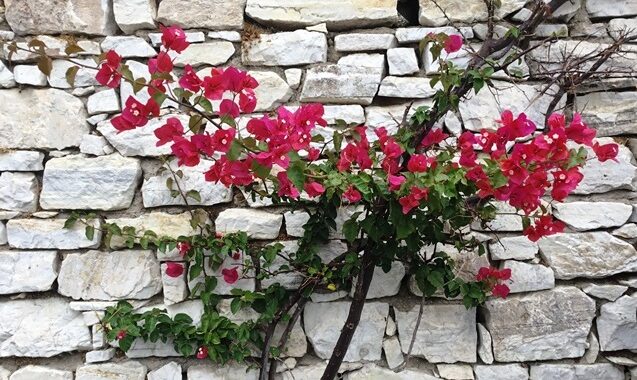
A marble wall.
Paros’s greatest claim to fame is its extremely clear, luminous, and soft-textured marble, considered the finest and most sought-after in the ancient world. From the 7th century BC onward, marble was mined at the island’s famed Marathi quarries. Up to three-quarters of the works excavated in the Aegean are of Parian marble, including the Acropolis and the Temple of Apollo on Delos Island. Abandoned by the 7th century AD, the quarries were revived in the 19th century by a French company that mined the marble for Napoleon’s tomb, then abandoned again. Today, a marble-strewn path leads into the quarried valley, and marble walls, buildings, and sculptures are found everywhere on the island.
Church of a Hundred Doors:

The Frankish Castle in Parikia.
We toured the old quarter in the main town of Parikia, getting lost in the meandering mazes of narrow alleyways lined with whitewashed houses, many of which have been converted into shops, before being spewed into a large plaza facing the sea. One curious structure is the Frankish Castle, built of Parian marble by the Venetians in the 1200s atop older sanctuaries.
Of great renown is Ekatondapyliani, the Church of a Hundred Doors. When part of the Byzantine Empire, the people of Paros converted to Christianity and built numerous churches, chapels, and monasteries. The first was Ekatondapyliani, from the 5th century AD, making it Greece’s oldest church in continuous use, an important Orthodox pilgrimage site, and a revered Byzantine monument. A courtyard leads into the church proper—three connected stone buildings, highlighted by many doors and topped by a dome. Inside, the sanctuary is beautifully ornate, with a giant chandelier, dozens of painted icons on the walls, and an altar which can only be entered by the priests. Legends abound. In one, Emperor Constantine’s mother, St. Helen, had a vision and vowed to build a church on the site. In another, the church’s architect Ignatios did such an impressive job that his jealous master, Isidoros (of the Agía Sofía in Constantinople) threw him off a cliff, but Ignatios grabbed his master’s foot and they both plunged to their deaths. In a third, only 99 doors have been located; when the hundredth is found, Constantinople will return to Greek rule. Hmm…
Food and Drink:

Lefkes.
Paros provided some of the best food experiences on our trip. The first day, we lunched at a taberna on typical Greek dishes—a salad of tomatoes, red onions, cucumbers, and a large chunk of feta cheese, all dribbled with oil and vinegar; zucchini croquettes; swordfish steaks on a bed of stewed potatoes, red peppers, eggplant, and tomatoes; and, for dessert, yoghurt and honey. Later in the day, we sampled ouzo, a popular anise-flavored aperitif, before dining on more salad, fried and breaded sardines, shrimp, calamari, and mussels, with a grainy ice cream for dessert. Throughout the Aegean, we were served plentiful portions of food. According to one Greek’s theory, this generosity springs from the privations of World War II, when Greece was occupied by the Germans and Italians and many people starved. Today, Greeks rejoice in having an abundance to offer guests.

Cooking at Anezina Village. Courtesy John Harmon.
The next day we drove to the picturesque seaside town of Naoussa, where a square harbor is edged in fishing boats, and whitewashed homes tumble down a hillside. The day was cool and drizzly, and though fisherman milled about, we were virtually the only tourists in town, a rare (even in October) and pleasant experience. We then wound inland to Lefkes. Once the island capital, Lefkes is now a rural mountain village of medieval homes, marble walls, steep streets, and small plazas. Here we sampled Greek coffee. Thick and lightly sweetened, it is excellent—as long as you stop sipping before the dregs. Next, we returned to the coast, to Anezina Village in Dryos, where for the next three hours we became chefs. Helped (mightily) by several professional cooks, we first made a toast—“yamas” in Greek—with a moonshine-like liquor, then went on to prepare, and eat, green salad, potato salad, spinach pie, steamed mussels, stuffed tomatoes, Greek lasagna, and moist orange cake, all washed down with Greek wine. It was wonderful, and we didn’t eat again that day.
Sounds like a place I’d love to visit!
Sent from my iPhone
<
div dir=”ltr”>
<
blockquote type=”cite”>
Thanks, Randy. It was beautiful, although I wish it had been warm enough to enjoy the beaches!
Your ferry ride sounds much better than ours. We were astonished to watch what looked like a thousand German camper vans and house trailers drive into the hold of our ferry from Trieste to Patras….our cabin was hot and windowless and we spent some time on deck trying to spot signs of life along the Albanian coast (it was well hidden). I still remember the food on Paros and I wish we could have had the variety you write about!
It really helped that we were led, like sheep, by our tour guide. She knew exactly where to take us on the boat and when. Our food was better on Paros than Mykonos, I think in part because Road Scholar got more for their budgeted money on Paros, i.e. more fish and seafood.