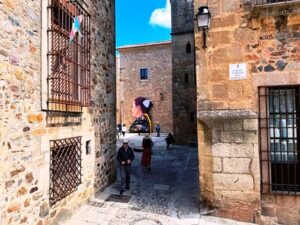
“You’ve got to go to Cáceres.” I heard that suggestion from just about every seasoned traveler to Spain when they learned we would be visiting the Extremadura region. “It’s amazing.” They were not alone in their praise. The city has received numerous awards and accolades. In 1986, UNESCO declared it a World Heritage Site for its exceptionally preserved blend of Roman, Moorish, Northern Gothic, and Italian Renaissance architecture. So, after exploring the Roman monuments in the city of Mérida, we made our way north to Cáceres. Outside the city walls, we waited for an attendant from the parador where we were staying to drive us to a nearby parking lot, then transport us, car-less, into the much-anticipated Old Town.
Going Way, Way Back in Time
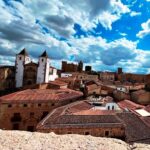
Like everywhere in southern Spain, the history of Caceres includes a mix of Roman (founders of the city in 25 BC), Visogoth, Arab, Jewish, and Christian settlers, but it also has something unique. In a nearby park, the Maltravieso Cave (closed to the public) contains some of the oldest examples of cave art in the world. One of its numerous hand paintings dates back 67,000 years, long before Homo Sapiens appeared in Europe. Which means the hands are the work of Neanderthal artists. Artifacts found in the cave are on display in the Museo de Cáceres.
The Maze
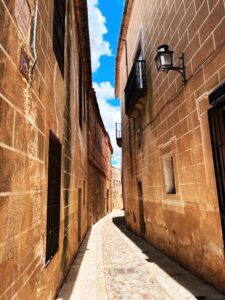
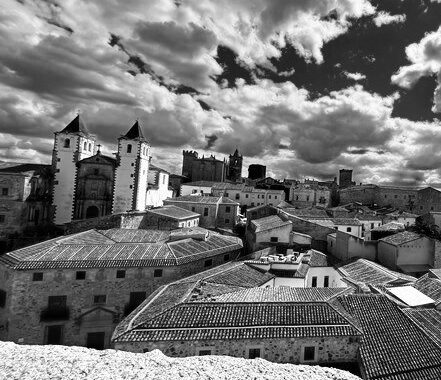
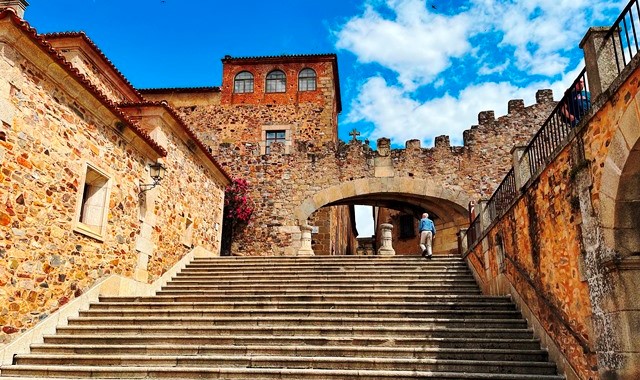
Cathedrals and churches, convents and monasteries, palaces and castles, museums and shops adjoin each other within the Old Town walls. There are no contemporary details on the unpainted stone building facades and tile roofs, only ornate balconies, storks’ nests, towers, and hundreds of escutcheons bearing coats of arms. Walking through the maze of narrow cobbled streets is like walking through an ancient city. In spite of numerous attempts, I could never get my bearings. Oversized posters in small parks presumably help orient visitors, but even with them and my GPS, I remained lost most of the time.
Curiosities
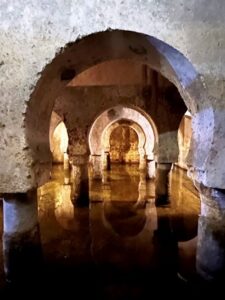
Cáceres gives visitors a glimpse of a wealthy medieval town. Many members of families in Extremadura voyaged to the New World, made their fortunes from the riches there, and built mansions in Cáceres. The white-domed Palacio de Toledo-Moctezuma housed the conquistador Juan Cano Saavedra and his wife, the daughter of the Aztec emperor Moctezuma II. Another mansion features Torre de la Cigüeñas (storks), the only complete tower remaining from dozens which had been built by squabbling rival families as shows of power. Only one of those families backed Isabella in her fight for the crown, and after she became queen, she had all the other towers truncated. A sixteenth century Renaissance mansion, Casa de las Veletas, was built atop a large geometrically stunning twelfth century Arab cistern well. Today the building houses the Museo de Cáceres, a lovely museum with exhibits from the first settlers to contemporary art.
The Jewish Quarter
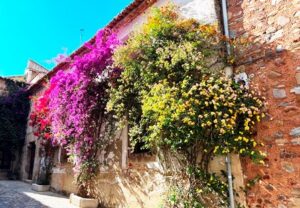
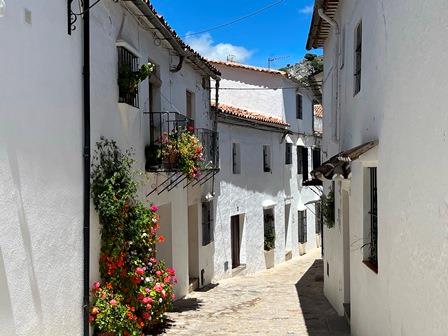
In contrast to most of the Old Town, the restored Jewish quarter homes in the Barrio de San Antonio are whitewashed and brightened by tumbling flowers. The Sephardic Jews, those with roots in the Iberian Peninsula, had lived in Cáceres since Roman times. During Muslim rule, the Jews had a protected status, with certain restrictions, in exchange for paying taxes. They flourished culturally, intellectually, and economically, in trades such as doctors, bankers, and merchants. However, with the advent of Christianity, the Jews faced increasing persecution. In Cáceres in 1470, their synagogue was taken over and converted into a chapel, the Ermita de San Antonio. (Some elements of the synagogue survive and can be visited.) Twenty-two years later, all Jews were expelled from Spain.
Migas and Other Local Foods
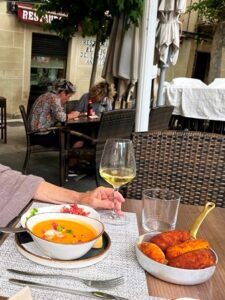
Migas was one of the more unusual food items we encountered in Andalusia and Extremadura. We found it on just about every menu in the paradores where we stayed, dubiously translated into English as “crumbs.” One day I tried it. It is very filling, similar to hash browns but with stale bread that has been moistened and fried in olive oil, with garlic and paprika and sometimes chorizo or bacon added to the mix. Iberian ham, or Jabón Ibérico, is another local favorite. It is produced from the native Iberian pig which has been fed on acorns, and the meat is cured for up to four years. I bought some at the Seville airport to enjoy at home, but due to my foolish honesty, it was confiscated at JFK customs in New York. Other specialties to Cáceres are the torta del Casar, a semi-hard cheese made from sheep’s milk, and morcilla patatera, a potato sausage. However, just about anything tasted good when sitting in an open-air restaurant in the Plaza Mayor, looking up at the marvelous Cáceres architecture.