Many years ago, at a gathering of English professors from the University of Puerto Rico, one of the professors announced she was going to write a mystery novel. “How hard can it be?” After all, she went on, she knew literature, read a lot, and authored professional papers. Many mystery books, she added, were poorly written. Why, with her expertise, she could write a better book and make some money on the side.
The years went by. Silence. If she did indeed complete a novel, mystery or otherwise, it never created any waves that reached me.
Transitioning from nonfiction to fiction writing is not as easy as it may seem. I found this out when I decided to write my own mystery book.
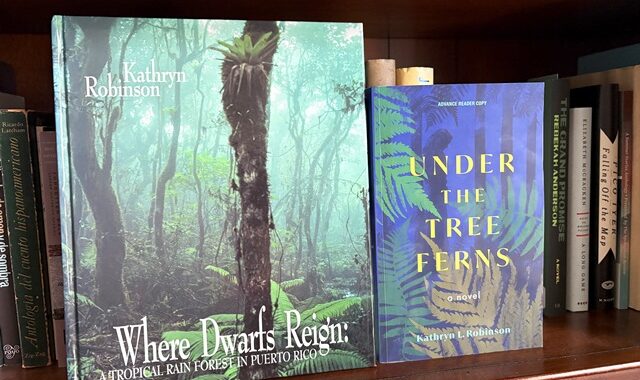
I’d spent many years in Puerto Rico writing nonfiction travel pieces. My most ambitious project was a book titled Where Dwarfs Reign: A Tropical Rain Forest in Puerto Rico. The forest inspired me to try my hand at writing a novel, a mystery novel set in a rain forest. I began the book in Puerto Rico, put it aside for freelance and teaching jobs, and took it up again after my husband and I moved to Spokane, Washington in 2013.
In what I consider an act of divine providence, a tiny, temporary notice in the local Spokesman Review newspaper caught my eye. It announced a novelists’ critiquing group that met in a nearby town. With excitement (and a bit of dread), I answered the notice and became part of the group. From that moment, my transition from nonfiction to fiction writing began in earnest.
In the meetings, each author read up to ten double-spaced pages of their work, followed by comments from the others. Comments could range from glowing to scorching. In the early years, the comments I received rarely reached glowing. Gentler critiquers would start out with praise for my writing and my descriptions (a result of all the travel pieces I’d done), then go on to enumerate the pages’ many flaws:
“The plot doesn’t move along fast enough.”
“This is an information dump.”
“The character is dull and two-dimensional.”
“There’s no hook at the end of the chapter.”
“Add more beats.”
“Every action needs a reaction. Where’s the reaction?”
“Show, don’t tell.”
“Rewrite, rewrite, rewrite!”
At times I’d leave the meetings fuming and frustrated. In my mind, I would rebut the charges, stubbornly clinging to my nonfiction ways. Why do I have to write the character’s reaction? Shouldn’t the reader infer it? Maybe I should join an experimental writing group, where anything goes. But when I calmed down, I realized the critiques were for the most part valid.
It took a long time, but my fiction writing did improve. All the strategies impressed on me worked to make the barebones storyline come alive. Whenever the novel began to sag, the voices of my fellow critiquers whispered in my ears: show, don’t tell; add more beats. As an added bonus, I became part of a group in a city that was new and unfamiliar to me. That meant as much as the critiquing itself.
In June of ’26, my novel, Under the Tree Ferns, will appear on bookshelves. (FYI, three more novels wait in the wings: once I finished the first, I wanted to stay in the group, and to do so I had to keep writing!)
Was my transition from nonfiction to fiction successful? Read the novel and let me know.