My fascination with the Anza-Borrego Desert began years ago, when my husband and older daughter (then a baby; now a mother herself) camped there overnight, enjoying spectacular carpets of colorful spring flowers during the day and pinpricks of stars against a black sky at night. Today, Anza-Borrego is officially designated as an International Dark Sky Park and traffic clogs the roads when the flowers are in bloom, but for the most part it remains a place of secluded desert beauty.

The desert in winter
What’s in a name?
Largest state park in California, Anza-Borrego couples the region’s history and natural resources in its name. The Spanish explorer Juan Bautista de Anza lived in Mexico and took up his father’s crusade for a land route to the Spanish settlements on the west coast, leading an expedition across the desert in the 1770s. And borrego, Spanish word for a young lamb or sheep, refers to the desert’s iconic bighorn sheep, known for their large curved horns and sure-footedness on steep mountain slopes.
Of mountains and badlands:

Borrego Badlands
Millions of years ago, the region alternated between being underwater, flooded by ancient seas, and above water in a lush environment similar to that of today’s Caribbean. At the same time, southern California went through cataclysmic geological movements that produced today’s mountains and valleys. In recent times, water and wind eroded down what nature had thrust up. As the region became drier, plant life became scarcer, laying bare ageless geological formations — ridges, ravines, canyons, caves, sandstone sculptures, dry washes and lake beds — all brushed with earth-tone hues. Most impressive are Anza-Borrego’s badlands, byzantine mazes of extensively eroded terrain that resemble the Grand Canyon in miniature. Trails and rugged tracks lead around and about the formations.
Summer heat – curse or blessing?

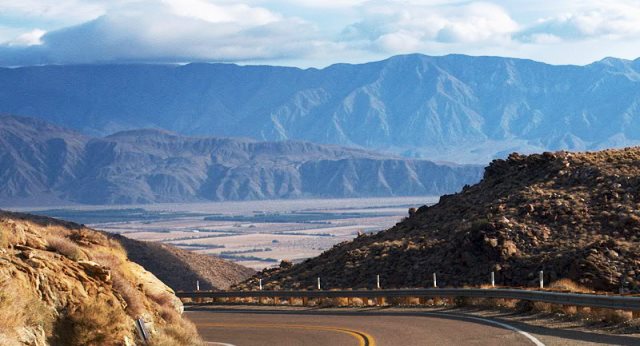
Highway S-22 [Wikipedia Commons]
The desert floor is, for most people, unbearably hot in the summer. The average high temperatures from June through September hover above 100 degrees F. This eliminates all but the hardiest – some 3,500 residents – from relocating on the private land in the heart of the state park and transforming it into another suburb of San Diego. Over the years, Anza-Borrego has attracted its share of eccentrics, mostly notably gold miners and desert ascetics.
Borrego Springs:

Borrego Springs remains a pleasantly quirky, spread-out town of small shops and galleries, streets with names like Christmas Circle and Frying Pan Road, and over a hundred larger-than-life metal sculptures of prehistoric and fantastical creatures created by Ricardo Breceda. For the winter snowbirds, the town has resorts, restaurants, campgrounds, golf courses, and, of course, the state park with a lovely visitors’ center. Of all the trails in the park, the most popular one follows Borrego Palm Canyon, a rare place of moist soil that shelters a number of fan palms, California’s only native palm. Clusters of green fronds rise above older leaves on a trunk that resembles an old man’s beard.
And every day there’s the promise of unforgettable sunrises and sunsets.