Author’s note: To get the most out of this story, I recommend you first read the previous blog about the place. Thanks!
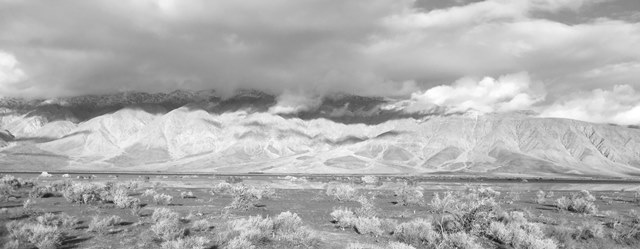
1958: Dan Lanyard trudged up a remote Anza-Borrego hill. Though long past midnight, the moon was full, the sky, clear. He could easily make his way around boulders, scrub bushes, and cacti spread across the sand, even with all the beer and whisky that jostled in his stomach. Beyond one exceptionally large boulder, his house came into view.
Well, it wasn’t exactly his house. It was a place he’d stumbled upon several years earlier in his desert travels. Quite small, it had thick adobe walls, a corrugated metal roof, and large windows, the panes missing or cracked. Inside, a dilapidated sofa and wooden rocking chair remained from the previous occupant, but a thick layer of dust everywhere indicated that person was long gone. Dan tossed his sleeping bag on the floor and returned to the house whenever he was in the desert. A year ago, he moved in full time. With Myra.
Though Dan loved the desert, with its purifying heat and views unsullied by humidity or pollution, that wasn’t the main reason he explored its nooks and crannies. He descended from a long line of dreamers and schemers. Dan’s dream involved finding gold in the Anza-Borrego hills.
After all, a century earlier the explorer Pegleg Smith had found gold—solid nuggets—in the surrounding hills. The site had never been exploited, not even by Smith himself, who had to flee the region before he could do so. But he’d drawn maps of the mine’s location . . . Finding one of those maps would mean finding the site, of that Dan was certain.
His one nod to civilization was a monthly visit to the Last Chance Bar in the small town of Borrego Springs, a seven-mile walk from the house. At the bar, he met Myra, and it was she who convinced him to move full-time to the desert.
Both of them were refugees from metropolitan Los Angeles. Myra, a plain woman with undersized eyes and an oversized nose, combed the desert for the lovely remains of Native American pottery. “If we’re here all the time,” she reasoned, “we have greater chances of finding what we’re looking for.”
They fixed up the place as best they could. Myra decorated with new-found pottery and dried sprigs of wildflowers. Dan tacked up a tarp against the front of the house for shade, and they found two folding chairs in town to go beneath it. They survived off beans, seeds, and nuts, and pulled water in five-gallon containers up the hill on a makeshift cart. Before dawn, each took off on their own separate searches for the treasures of the desert; by night, they sat in the folding chairs, counting stars in a black sky.
Dan had forgotten how nice it was to live in the company of another person, which was why a part of him couldn’t believe what he’d done tonight at the Last Chance. He and Myra had brought their savings with them to the bar, a hundred dollars, primarily earned through the sale of Myra’s Native American pottery. The plan was to stay overnight in town, then make their way to Los Angeles, where they would spend a month visiting family and enjoying the comforts of civilization.
Halfway through the evening, a leathery stranger sat down next to Dan. Leaning close, he spoke in a whisper. “I hear you’re interested in Pegleg’s map.”
Though he feigned nonchalance, Dan stiffened with excitement. “I’ve come to wonder if it ain’t just a myth.”
The stranger puckered his wrinkled face. “Myth? Then what’s this?” He pulled a yellowed, oft-folded, stained document from a shirt pocket and opened it up, being careful to keep it from Myra’s view. There it was, a map of Ghost Mountain, with drawings of landmarks, a dotted line and an x, and minute annotations on the side. “I’m only offering it to you ‘cause I hear you’re a bonafide prospector.”
Dan’s heart knocked against his ribcage. “How much?”
“Ninety-nine dollars.”
After the stranger left and Dan could hide his excitement no longer, he confessed to Myra what he’d done. She responded by slapping him in the face and stomping out of the bar, but not before she shouted out for everyone to hear, “You’re a self-centered dimwit! I never want to see you again.”
Once he reached the house, Dan sat in one of the two folding chairs, pulled the map from his pant pocket and unfolded it. Pegleg Smith’s map—signed by the man himself. At long last. Yet somehow having it in his possession didn’t thrill him the way he thought it would, and he had to shrug off dark thoughts that it might just be a piece of paper.
You had better let us see how this story ends!
Hi Randy,
So good to hear from you! I hope you and your family are in good health and good spirits.
As for the story, due to its brief nature, I must report that Dan’s dark thoughts proved true — he was swindled by the leathery stranger, who sold him a worthless piece of paper. If I ever expand on the story, I could add some fantastical twists and turns.