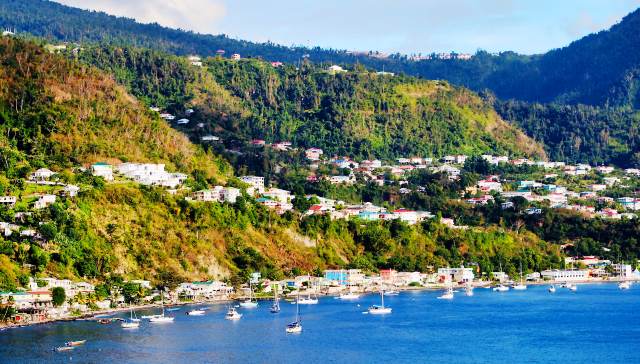
Of the many places my husband and I visited while we were living in the Caribbean, Dominica remains one of the most memorable. This is not the well-known Dominican Republic, but a small (29 by 16 miles) off-the-beaten-path island halfway down the Lesser Antilles archipelago. Rich in lush tropical forests, mountain peaks, and a river for every day of the year, Dominica is nicknamed the nature island and is unsurpassed for eco-tourism when not crippled by passing hurricanes.

Dominica, MaxPixel
A recent island:
Relatively young at 26 million years, Dominica is one of the last Caribbean islands to be formed by volcanic forces. Indigenous groups first settled here thousands of years ago, with the Kalinago (Caribs) predominant when Europeans first sailed through. In the 1600s, the island was neutral and remained home to indigenous groups; in the 1700s, it was taken over by the French; in the 1800s and beyond, by the British. In 1978, Dominica received independence from the United Kingdom, making it a newly formed republic when we visited some four years later.
Our visit:

Carib Territory, Hans Hillewaert, Wiki Commons
All the attributes that make Dominica such a great place for eco-tourism existed when we were there, in the early 1980s, but they had not yet been developed and packaged. After a long, winding, and lovely taxi ride from the airport across the island, we stayed in a modest wooden hotel in the capital, Roseau. During our visit, we enjoyed a long black-sand beach next to the hotel and a drive to the Carib (Kalinago) Territory, one of the last indigenous reservations in the Caribbean; another drive down the coast to Scotts Head with a stop in a secluded resort where we were served a rum punch I have tried for decades to recreate, with a modest degree of success, and were asked if we might be tempted to buy the resort; and a third drive to the blue-green waters of Emerald Lake and a brief swim in Freshwater Lake. But the main adventure of our stay on Dominica was the hike to the Boiling Lake.
The Boiling Lake:

Boiling Lake, Goran Hoglund, Flickr
The second-largest in the world (after one in New Zealand), Dominica’s Boiling Lake is a flooded fumerole, that is, an opening in the ground that emits steam and gas from underlying molten magma. Some 200 feet across in a cauldron of rock, the grayish water bubbles and burps, though often hidden under veils of water vapor, and its rotten-egg smell comes from sulfur. Set in a remote part of the Morne Trois Pitons National Park, a World Heritage Site, views from the Boiling Lake extend across the mountains down to the ocean and over to Martinique. The lake has historically gone through fluctuations. In the late 1800s, it was deep, then it vanished into a mere fountain of hot water and gas. In the early 2000s, the lake dropped, then rose, then, around 2016, dropped drastically and cooled off. Photos surfaced of people swimming in the water, a foolhardy venture considering the lake’s ability to cool, drop, rise, and/or boil at a moment’s notice. Today, it seems to be full and boiling again.
The Boiling Lake Trail:
In order to complete this hike safely, we hired a local guide, quite possibly a grandfather of one of today’s guides. Before starting, he showed us a small plot of land where he grew carrots and other vegetables on mounds to protect them from the frequent rains. The trail is a long, steep, hot, humid, and muddy slog, some 6.5 miles and three-plus hours one way. First, we ascended and descended a mountain ridge (Morne Nicholls), where exquisite stands of slow-growing dwarf forest had been sheared by Hurricane David in 1979. We skidded down and across the marvelously named Valley of Desolation, an otherworldly setting of steaming fumaroles, bubbling mud, warm streams, and crusty patches of ground. Then up and down through more forest and, finally, to clouds of vapor indicating the lake. Once there, we sat for a while and watched the vapor do a dance of the veils over the lake before retracing our steps, exhausted and completely coated in mud that permanently stained clothes and boots. We celebrated with a dinner of Dominican mountain chicken, actually a frog, a popular local dish back then. However, now the frog is endangered, and the dish, one hopes, is off the menu.

Roseau, Dominica, pxfuel.com
You thoroughly captured my attention with the tale of your experience with this remarkabe place!
On Sun, Oct 31, 2021, 1:06 PM Tree Ferns and Snow Globes wrote:
> Tree Ferns and Snow Globes posted: “Of the many places my husband and I > visited while we were living in the Caribbean, Dominica remains one of the > most memorable. This is not the well-known Dominican Republic, but a small > (29 by 16 miles) off-the-beaten-path island halfway down the Lesser A” >
Thanks! I don’t think I could do that hike today!