Some months ago, a friend from Spokane and her husband announced they were moving to Juneau, Alaska. As fellow senior citizens, their move to Alaska seemed as wrong-directioned as our own move from Puerto Rico to Spokane. The announcement sparked in me a curiosity about the city. As Alaska’s state capital, Juneau is the largest capital in the U.S. in terms of size but small in population, with a scant 32,000 souls. More paradoxically, it is not an island but can only be accessed by plane or boat. Why?

Downtown Juneau, courtesy Bill & Vicky Tracey
A brief geography lesson:
The shape of Alaska reminds me of a bison head, with two tendrils leading off in opposite directions where the neck would be. To the west, the Aleutian Islands arc toward Russia; to the east, an archipelago and narrow strip of coastline immediately ram into forbidding coastal mountains and, just beyond, the border with Canada. On this panhandle lies Juneau. Of the 3,255 square miles within the city’s borders, approximately ninety percent consists of water, rugged mountains, or glacial ice caps.

Tramway to Mt. Roberts, courtesy Sonny SideUp
The warmish currents of the Pacific Ocean usher in a relatively mild, wet maritime climate along the panhandle. Hemlock and Sitka Spruce trees predominate in lush temperate rainforests. An outer fringe of various-sized islands, the Anderson Archipelago, resembles pieces of a jigsaw puzzle separated from the skinny coast by channels and inlets. Historic downtown Juneau squeezes between towering Mount Juneau and the narrow Gastineau Channel that separates the mainland from Douglas Island. Since those early days, the City and Borough of Juneau (CBJ in our acronym-friendly times) has spread out to nearby nooks of accessible land, including Douglas Island by way of a bridge. Today, the largest residential area lies along Mendenhall Valley, with up-close views of Mendenhall Glacier creeping into the lake of the same name. A lone highway some forty miles long parallels the coast and connects the city’s neighborhoods. Beyond, rugged terrain impedes further construction. Which is why people and goods arrive and depart by plane or boat.
History in brief:

Gold Creek, courtesy Jsayre64
The first humans reached Alaska more than ten thousand years ago from Asia. When Europeans began to explore the coast some three centuries past, Tlingit Indians lived there in clan villages. They fed off the abundant forest and marine life, particularly salmon, and excelled in woodworking, crafting houses, canoes, and elaborate memorial totem poles. The Russians were the first outsiders to arrive, and they primarily hunted for sea otter pelts and other furs. In 1867, the U.S. purchased Alaska from Russia. For a while, not much happened. Then rumors of gold brought in pioneering prospectors. With the help of local Tlingits, gold was found, mining operations sprang up, and Juneau became a town. For more than half a century, gold mining operations dominated the region’s economy and, for a time, produced the largest supply of low-grade gold ore in the world.

Downtown street, courtesy Bernard Spragg
The town grew. In 1900, the territorial government moved to Juneau, and, when mining began to decline in the 1930s, government work along with fishing and logging kept the city prosperous. More recently, tourism has become a booming industry. In summer months, prepandemic, over a million visitors descended on the city by plane or cruise ship in summer months, with about one-third that number in the winter. What do all those people do when they get here?
What to do:

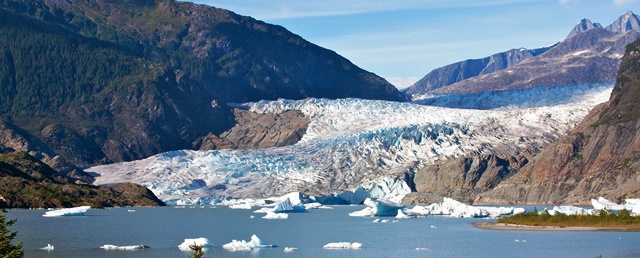
Mendenhall Glacier, courtesy Jay Galvin
Wedged between channel and mountain, the picturesque historic downtown district features old Victorian homes, the governor’s mansion, government buildings, a Russian Orthodox church, and museums highlighting Tlingit traditions, the region’s natural history, and the city’s lively mining history. A tramway rises to the top of Mount Roberts and a stunning panorama of the mountains, channels and islands of this northern stretch of the Inside Passage. Several miles to the north, Mendenhall Glacier, over a mile wide and 150 feet deep, slides ever-so-slowly between the mountains, and can be observed from observation points, or, up close, by hiking, floating, canoeing, or sea kayaking. Dozens of tours offer visitors opportunities to view brown bears, mine for gold, partake of traditional salmon bakes, observe humpback and orca whales, and wander through temperate rainforest gardens. Not to mention eat, drink, and sleep.
For more information, visit the Travel Juneau website.