Author’s note: To get the most out of this story, I recommend you first read the previous blog about the place. Thanks!
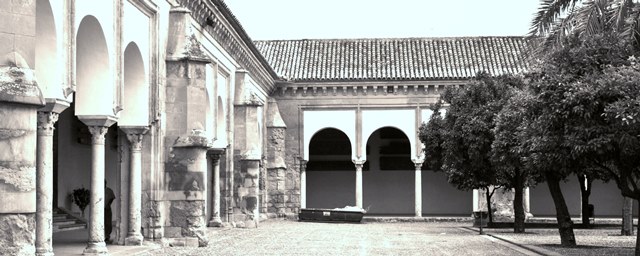
It was a mistake to visit Córdoba in August, I admitted as I sank to the ground and propped myself against a wall under the loggia in the mosque’s Courtyard of the Oranges. The loggia’s shade provided scant relief from the brutal sun that baked the oranges and boiled my body’s fluids. But scant relief was better than none.
My husband Harold and I had just toured the Mezquita-Catedral, where the dim light did little to refute the notion we were walking through a sauna. Harold left the courtyard to buy us more bottled water. I closed my eyes and breathed in the heavy air. When I opened them, a man, a stranger, was sitting next to me. Dressed in a make-shift collection of shirt, trousers, scarf, and shawl, his beard and hair untended, he looked like a down-on-his-luck resident of the city.
“Hot, isn’t it?” he commiserated.
I merely nodded and hoped Harold would return soon.
“Do you know the legend of Fulayh al-Ubaid?”
Startled, I struggled for words, but before I could offer a reply, he launched into his tale.
“In a time long ago, when the Muslims still ruled the Iberian Peninsula, though in decline, one man killed another. The murderer, Fulayh, was Muslim, and the victim a Christian. Fulayh hadn’t meant to kill the Christian, but when he saw the man spit into the neighborhood well, it incensed him and, without thinking, he drew his dagger and stabbed the man’s chest. Fatally, as it turned out. In their weakened circumstances, the Muslim authorities didn’t want to antagonize those of other religions, for they paid taxes to the caliphate. So they posted a notice to apprehend the Muslim. He escaped into the mosque and was never seen again.”
Not much of a legend, I thought. Where is Harold?
“He was never seen,” the stranger continued, “because he was a clever man and knew how to disguise his appearance with clothes cast off by over-heated worshippers and a long beard and hair, blending in with the other mendicants begging for alms. For decades Fulayh lived in the Mezquita, soliciting in the courtyard and sleeping in remote corners of the immense mosque.
“Then in 1236, following a several-months siege, the Castilian king entered the city. Muslim rule ended, and Christian rule began. Over the years, the Mezquita remained intact but Christian trappings seeped in—altars and chapels, Christian tombs, and wine used in sacraments. One day Fulayh discovered a half-full bottle of wine. For the first time, he drank an intoxicant. The taste pleased him, but he could little control its effects. He became addicted to the beverage.
“One night, in a drunken stupor, he fell into a newly excavated tomb and did not wake when workers, who could scarcely see in the dim candlelight, placed a body on top of him and sealed the tomb.”
In spite of the ovenlike temperatures, I shivered. Being buried alive struck me as a particularly horrifying way to die.
“For centuries, Fulayh’s ghost has wandered through the Mezquita, exposing himself to Christian visitors, ever searching for bottles of wine.” He stared at my oversized purse.
My face felt as slack as melting wax, and I surreptitiously patted my purse to confirm it held no wine bottles. “And how do you know all this?”
“I have personally watched him do so.” The stranger looked at me so intently his eyes seemed to cross.
Scrambling to my feet, I fled the loggia just as Harold crossed the courtyard with two water bottles in tow. He approached me with a puzzled look. “I saw you talking to yourself. Here, take the water. Don’t let the heat get to you.”
“I’m not talking to—“
When I turned, the stranger was gone.
“—myself.”