Ukraine is in the news, for tragic reasons. As the war continues, I’ve wondered about Ukraine’s land, its culture, and the landmarks one could visit in more peaceful times. With a bit of research, I came upon an intriguing ancient city – Kamianets-Podilskyi, in the historic region of Poldolia in southwestern Ukraine, just above the northern border of Moldova and Romania. Though this region is far from the current fighting, it nevertheless is included in Tripadvisor’s warning to “avoid all travel to Ukraine due to armed conflict and serious safety risks.” So for the near future, it will have to be a virtual journey to this landlocked city that resembles an island and has been embroiled in conflicts and changing sovereignties for over a thousand years.

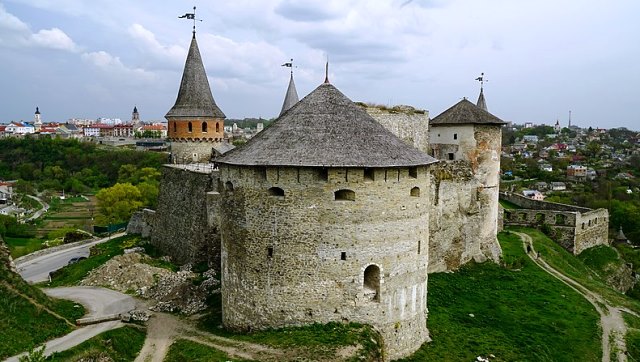
The bridge and castle of Kamianets-Podilski. Courtesy Hakan Henriksson.
What’s in a name?
Geography is what. Originating from Old Slavic words, Kamianets means ‘stone,’ and Podilskyi refers to the historic region of Poldolia, which in turn means ‘by a valley.’ Geography plays a crucial role in the city’s founding. Millennia ago, the Smotrych River carved a deep canyon in an almost perfect horseshoe shape around a high plateau. Limestone cliffs over a hundred fifty feet surround it, resulting in only one narrow entrance onto the plateau, making this an almost impregnable site.
A coveted ‘island’

A detail of the castle and city. Courtesy Kayahob Ceprin.
The region has hosted human habitation dating back to Paleolithic times. Today’s Kamianets-Podilskyi was first mentioned in the 11th century as part of a medieval Eastern Slavic principality. From then, the canyon-rimmed plateau passed through a complex, confusing succession of rulers. Early on, the Mongols invaded, followed by Lithuanians, and, in 1430, Poles. For two centuries, Poland controlled the town, which became the capital of historic Podolia and grew into a center for international trade and craftwork. A large fortress rose up at the entrance to Kamianets-Podilskyi, and walls and towers fortified the town. Briefly, it fell to the Turks, then back to Polish rule, and on to Russian rule in the 1800s. Cultural distinctions revolved around religion—Catholic, Orthodox, and Jewish—and there were societies, museums, schools, and universities. For a brief period at the close of World War I, the city became part of an independent Ukraine, only to fall under Soviet rule in 1920. With the dissolution of the Soviet Union, Ukraine received full independence in 1991. A stone monument in Kamianets-Podilskyi pays homage to the seven nationalities that have contributed to its culture – Ukrainians, Poles, Lithuanians, Jews, Turks, Armenians, and Tatars.
The virtual tour

A street in Old Town. Courtesy DiscoverWithDima.
A city of approximately 100,000 residents, Kamianets-Podilskyi features an Old Town and newer districts. Old Town sits on the canyon-rimmed plateau. It has narrow winding streets with buildings dating as far back as the 12th century – and none from the 20th century. Among the landmarks are a Dominican convent, a medieval-styled café, a miniature museum of Ukrainian castles, and the Saints Peter and Paul Cathedral. Built during the 14th century by the Catholic Poles, the cathedral was converted into a mosque by the Turks, who added a minaret. When the city reverted to the Poles, the minaret remained but was topped by a golden statue of the Virgin Mary. During the Soviet years, the church ironically became a museum of atheism. It is once again a cathedral.

Alexander Nevsky Cathedral. Courtesy Ashroet.
An impressive medieval canyon bridge leads to the city’s most famous attraction, the Kamianets-Podilskyi Castle. Built in the early 1300s, it underwent several renovations but remains a beautifully preserved limestone, brick, and stone fortification complete with flag-topped towers. Beyond Old Town, two stunning Orthodox churches rise above the more modern architecture – the Alexander Nevsky Cathedral with rounded domes painted in shimmery shades of gold and powder blue and the Church of St. George decked out in vibrant blue spires. For more information, visit the Vidviday blog.
The land beyond

Bakota Cave Monastery. Courtesy Yaroslava.
There are also places beyond the city that merit a visit. Trails lead through forested canyons and nearby mountains, and waterfalls cascade down limestone cliffs. Perhaps most intriguing is the Bakota Orthodox cave monastery ruins, some thirty miles southeast of Kamianets-Podilskyi. Carved into a white sandstone mountain and dating back at least as far as the 11th century, the caves were inhabited first by pagans, then monks, and, in times of danger, peasants from the neighboring city of Bakota. Frescoes and paintings adorn the walls, and the bodies of monks remain preserved. In the 1980s the nearby Dneister River was dammed, forming a large reservoir that includes Bakota Bay, now part of a lovely national nature park. This came at the expense of many now-submerged villages in the region, including Bakota. The monastery was only partially submerged, and, along with a spring said to have curative powers, remains a very-off-the-beaten-path tourist destination. For more information, visit the Vidviday blog.