Author’s note: To get the most out of this story, I recommend you first read the previous blog about the place. Thanks!
“Would you be willing to die for your faith?”
Brother Dmitrei thought of the question asked him by an elder monk the year he began his religious journey. He had nodded his head vigorously, never thinking he would have to put such a question to the test.
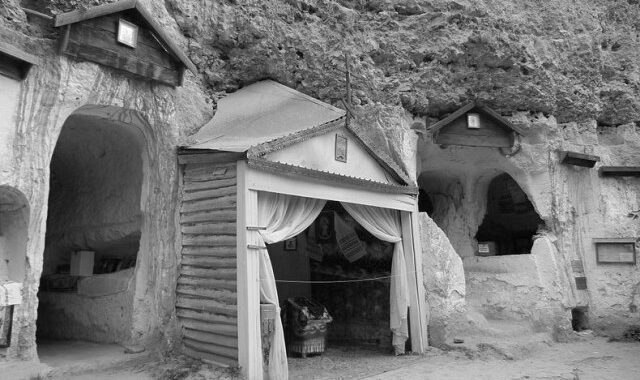
He rested his head on a silk pillow in the sleeping niche of his cave cell. The pillow, a Bible, and an illuminated portrait of the Madonna and child, passed down from his grandfather to his father to him, were the only extravagances he had brought with him to the monastery. In the cave’s darkness, he could scarcely see them, nor could he make out the vibrantly colored wall painting, drawn by a prior cave lodger whose body rested in a small cemetery next to the monastery. Even the off-white sandstone walls appeared gray in the gloom.
His cell, though scarcely the size of a closet in his former house, had been adequate for his needs – a niche carved out of the stone for a bed, a small wooden table and chair, a jug for water, and two pots, one for his daily ablutions and one for his bodily functions. After all, most days he would spend outside.
Now the space felt claustrophobic, and he had difficulty breathing. Brother Dmitrei tried to raise his body into a sitting position but was too weak to accomplish even such a simple task. His head returned to the pillow.
He was entirely alone now. Brother Stanislav had occupied the cell next to his. At the start of this agony, the two could talk through a small hole in the cell wall. But Brother Stanislav suffered from a weak constitution. Four days ago – or was it five, or six – the monk had succumbed to the lack of food and water. At first, Brother Dmitrei gagged on the stench of the monk’s decomposing body, wafting into his cell through the hole in the wall, as well as the accumulation of his own bodily wastes in the pot. But now he scarcely noticed. What did that mean?
The death of the monk, the absence of daily meal rituals, and the impossibility of reading his Bible in the absence of light left Brother Dmitrei with little to do other than pray and recall his past. He had taken monastic vows in mid-life, after his wife and son had died in a pestilence that ravaged his natal town. A learned man, he could read and write, and he had supplemented the modest income that came from his family’s estate to read legal tracts and other documents to the illiterate. In his grief following the death of his family, he renounced the worldly life, donating the family estate to the church and seeking union with God in a small cave monastery near the city of Bakota, a week’s journey away.
Brother Dmitrei had enjoyed life at the Bakota monastery. He rose before dawn for silent prayers and scripture reading, followed by a breakfast of porridge with honey. In the morning, the monks worked on chores. For Brother Dmitrei, this meant tending cabbage, barley, and other crops in the monastery plot. On market days, the monks went to the city to sell their crops and buy the necessities they couldn’t produce. At noontime, he meditated before lunch, usually of brown bread, cheese, and fruit. In the afternoons, Brother Dmitrei worked at his desk, copying Biblical passages. In the evenings, the monks shared a rich meat and vegetable stew accompanied by beer or mead and spent communal time in discussing religious matters. The day ended early with silent prayers and meditation. It was a simple life, but it suited Brother Dmitrei. He felt much closer to God, and his worldly pain receded as the years passed.
Then tragedy struck. Without warning, fierce Mongol warriors rode out of the East on horseback, wielding swords, catapulting fire, terrorizing and sacking one city after another. The horrors of the Mongol invasion arrived in Bakota before the warriors themselves. Horsemen of the Devil, the monks called them. When the Mongols did arrive, homes and government buildings were destroyed, those who fought back were slaughtered, and the wealthy were forced to pay tribute to the invaders. Many survivors fled to the monastery caves to seek refuge. Before long, however, the Mongols reached the monastery and demanded that all must renounce their Christian faith. Many did, even among the monks.
Not so Brother Dmitrei. How could he renounce the God who had offered him succor in his time of need, who made Himself known to him in all the mystical splendor of the omniscient and eternal? He, along with Brother Stanislav and others, refused.
“Then you will die!” vowed the Mongols.
A warrior had stood in the front of each cave cell, forcing at sword-point those who refused to renounce their faith to remain in the cells. Other warriors quickly blocked up the entrances with heavy boulders, rocks, and sand. “Let your Christian God save you!” they shouted as they rode away.
The boulders in the blocked entranceways wouldn’t budge. Silence and darkness filled the cells.
The water in the jug, which had only been half filled when the Mongols entombed Brother Dmitrei, ran out first. Berries the monk had collected days earlier helped slake his thirst, then they too were gone. In one corner lay a half-eaten loaf of brown bread, a sack of dried beans, and a small wedge of hard cheese.
A week after the entombment, Brother Stanislav died. After that, Brother Dmitrei lost track of the days. Over time, the agony of thirst had abated; the severe hunger pains in his stomach had subsided. He moved in and out of consciousness. Death was close at hand; he knew that.
In his moments of lucidity, Brother Dmitrei – fixed on meeting God face-to-face and entering the jubilant gates of Heaven – felt a muted euphoria.