Something new:
Up until now, I’ve written about places in three different regions – Chile, the Inland Northwest, and Puerto Rico. I’m now adding a new stop, using sites in multiple regions as settings for mini-stories inspired by them. One week, you’ll get acquainted with the place; the next week, its story. Let’s start with Mona Island, a setting worthy of many stories, the more ghostly the better.

Scrub forest along the coast (Wikipedia)
And we begin:
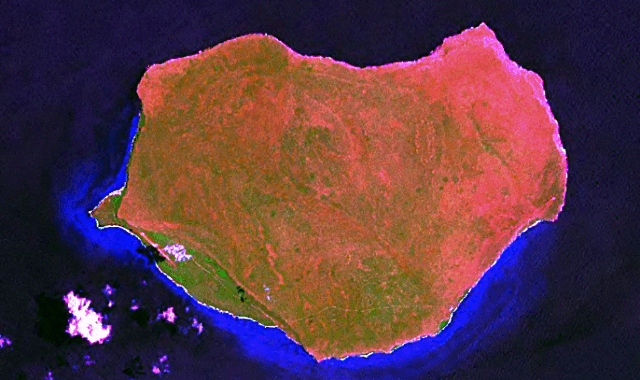
Mona Island pokes up in the middle of Mona Passage, halfway between Puerto Rico and Hispaniola (Dominican Republic /Haiti), a stubborn remnant of the time, millions of years ago, when a long, flat super-island extended from Cuba to the Virgen Islands. That this seven-by-four-mile, lima-bean-shaped island endures in the notoriously rough passage is nothing short of miraculous.

Satellite photo
A bit of history:
Over thousands of years, indigenous groups settled the island, the last wave being the Tainos, who used the island as a link in their Caribbean canoeing journeys. They enjoyed a simple life – raising crops, living in communal thatch bohíos, and gathering at ceremonial ball courts – until Europeans arrived in the New World. By the end of the 1500s, Tainos were gone from Mona. For more than three centuries, the respectable steered clear of the island, and it became a refuge for pirates and privateers, the best known being Captain Kidd. This brought a surge of quixotic seekers of buried treasure. Eventually, an operation for mining guano (bat and seabird poop, used as fertilizer) helped reestablish a degree of respectability. Today, Mona is a nature reserve. It has no permanent inhabitants, only rangers and biologists, adventure tourists and in-season hunters who stalk the feral pigs, goats, and cats that stalk endangered native species.
A Galapagos of the Caribbean:

Cliffs and alelí tree
Because of its distinct geological formation, its isolation, and its relative lack of development over the centuries, Mona shelters many natural curiosities. A dramatic limestone plateau looms over 200-foot cliffs to the north, then flattens out to several strips of white-sand beach along the other coasts. Deep ragged-toothed caves riddle the cliffs, and spectacular reefs and marine life – including endangered hawksbill turtles – populate exceptionally clear waters. Sunning on rocks, the yard-long Mona ground iguana resembles a creature of the dinosaur age. Land and hermit crabs scuttle about in the hot, dusty scrub forest. Cacti grow next to alelí trees, which, at certain times of years, blossom in a rare burst of color across the landscape. Boobies and a variety of seabirds nest on Mona and the smaller Monito island to the northwest.
Tall tales:

Beachside cave and (insert) brown booby
A number of natural and supernatural tales have arisen from Mona’s colorful history. Tales of Captain Kidd’s stay on Mona and the treasure he stored deep in a cave. Murdered maidens crying at night. Pirates who lost their heads. A farmer poisoned by liquor intended for a hated ship captain. A woman who lived in a cave and cooked for the guano miners. Treasure seekers who went crazy, drowned at sea with their new-found booty, or were seen in San Juan dressed in finery.
And my own tale, which I’ll post next time.
Have you been there?
Sent from my iPhone
>
Yes I have! Twice — stories in themselves. It’s a fascinating place and is a setting in my first book.