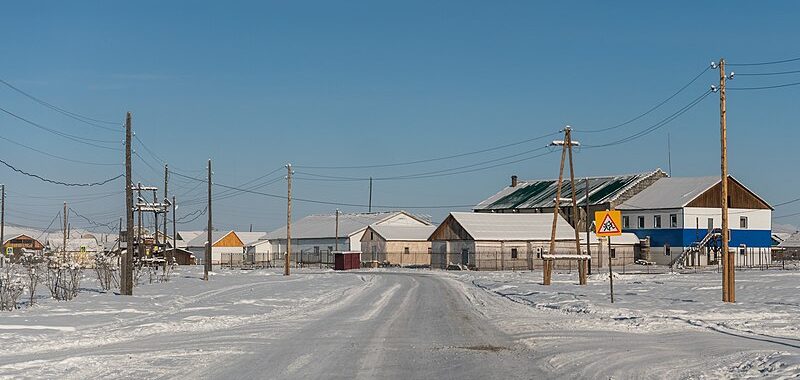
I’m writing this in the dog days of summer, when temperatures soar ever higher. The sun scorches, pavements sizzle, and even mad dogs and Englishmen search for shade. While we bake, many of us long for a respite, the colder the better. The deep heat brings on longings for swirling snow and howling winds, frosty breaths and chilled bones. You can find all that and more, much more—in Oymyakon, Russia, the coldest permanently inhabited settlement on Earth. Let’s take a look.

Oymyakon. Creative Commons: Ilya Varlamov.
The Pole of Cold:
Located close to the Arctic Circle in Russia’s eastern Siberia, Oymyakon, nicknamed the Pole of Cold for its extreme freeze, is a two-day drive from the nearest city, Yakutsk (similarly billed as the coldest city on Earth). The village consists of a few dozen modest homes, a post office, bank, gas tank, and school, all built on permafrost and heavily draped in meringue drifts of snow eight months of the year. Daylight shrinks to four hours in mid-winter. Given these extreme conditions, fewer than five hundred people make Oymyakon their home.

Oymyakon forests. Creative Commons: Maarten Takens.
The village shares the same latitude as Nome, Alaska, yet, while Nome’s winter lows hover in the minus teens Fahrenheit, in Oymyakon they plunge into the minus fifties. The reason lies in geography. Oymyakon sits flat valleys bordered by mountain ranges, far from warming oceans. Wind and cold air sink into the valleys, causing the bitter temperatures to linger. In fact, if you go to the top of nearby mountains, an increase of a thousand feet, the temperatures are actually warmer!
A monument in Oymyakon commemorates a day in 1924 when the temperature fell to a record minus 96 degrees. At such temperatures, if you throw hot water in the air, it turns to ice before it hits the ground; if you leave a bottle of vodka outside, it freezes; if you step out of your house naked, you die in a minute or two.
Origin Story:
Oymyakon got its start in the 1920s, when winter reindeer herders watered their deer at a nearby thermal spring (giving rise to Oymyakon’s somewhat ironic name, which means in Russian ‘water that doesn’t freeze’). The settlement lies near the infamous Road of Bones, built in unimaginable circumstances in the 1930s by Stalin’s prisoners. An airport was built nearby during World War II. Reindeer herding as well as hunting and ice fishing remain the region’s main industries, although recently the frigid distinctions have brought in modest tourism.

Chyskhaan. Creative Commons: Ilya Varlamov.
Oymyakon is home to a smattering of ethnic Russians and Ukrainians. Most residents, however, pertain to aboriginal groups, primarily the Evenks and Yakuts. Yakut, a Turkic ethnic group, originated in central-east Asia and migrated ever northward and eastward, eventually settling along the Lena River. Because of the inhospitable conditions of the land here, the Yakut is the least culturally absorbed group in Russia, and knowledge of the native Yakut language remains widespread. Most Christian villagers pertain to the Russian Orthodox Church. At the end of winter, the village holds the Pole of Cold Festival, which features folk costumes, dances, songs and legends, reindeer races, a beauty contest, national dishes, and a visit from Chyskhaan, the ‘guardian of the cold.’
Survival:

Truck. Creative Commons: Ilya Varlamov.
How does one survive when temperatures plunge into the minus fifties for months on end? Of course, the pipes freeze, so most toilets in Oymyakon are outhouses. Car engines also freeze, so cars must be parked in heated garages or kept running 24/7. Most buildings are heated by burning coal and wood. Virtually no crops grow on permafrost, so the local diet consists of dairy products, pancakes, meat, and fish. One popular dish is salted fish, sliced frozen. Water is obtained from melted snow. The streets are deserted, as venturing out is a serious proposition, and those who do so bundle to the hilt. Even then, eyelashes and saliva freeze. On the other hand, no refrigeration is needed at the local outdoor fish stands.
Heroic Adapters:

Yakutian horse and owner. Creative Commons: Ilya Varlamov.
The human body hasn’t much adapted to such extreme cold, but some species have. Most notable is the Yakutian horse. It can survive without shelter in temperatures as low as the record-breaking minus 96 degrees, and can locate and graze on vegetation buried under deep snow. A small horse resembling the Shetland pony, it has a thick mane and heavy coat of hair. When needed, it accumulates large fat reserves, produces anti-freezing compounds, and reduces the volume of circulating blood. Oymyakon residents consider horse meat a delicacy; the horse also provides milk and is used for riding. Other resilient animals include the Yakutian cattle, a Yakutian Laika working dog, and, of course, reindeer.
Common in the region around Oymyakon, the Dahurian larch is the northernmost tree—and the most cold-hardy tree—in the world, able to grow in shallow soil over permafrost. Medium in size, it is a deciduous conifer, with needles that turn yellow-orange before they fall. Adapted to long winters, it can tolerate temperatures below minus 70 degrees, but doesn’t do so well when transplanted to warmer climates.
Take the Tour:
Still intrigued? Then take a tour! Baikal Nature Tours offers several tours to the Pole of Cold—a general visit; a visit during the Pole of Cold Festival; or you can hunker down to ring out the old year in extreme fashion in their New Year’s Eve 2023 tour.
Wow! When are you going? Imagine teaching English there!
Fascinated though I am, I’ll focus my limited travels to warmer climates!
Quite a contrast from Greece and Spain. When are you visiting?
<
div>Randy
Sent from my iPhone
<
div dir=”ltr”>
<
blockquote type=”cite”>
Hmmm… That may remain a virtual visit!