The Río Camuy is one of dozens of rivers that get their start in Puerto Rico’s rugged Cordillera Central. What makes the northward-flowing Camuy different is this: at one point it vanishes into a cave entrance known as the Blue Hole, tumbles through a vast collection of underground caverns, falls, tunnels, lakes, and chasms, then resurfaces some four miles farther north and continues on its journey to the sea
Big:
Formed over the eons by water dissolving the region’s porous limestone, the Camuy is big—one of the largest cave and underground river systems in the world. Some ten miles of cave networks and more than 200 individual caves and a dozen entrances have been probed and plotted. Experts believe much more remains to be discovered. One of the caves, aptly named the Big Room, is 200 feet high and 600 feet long. Most of the entrances are sinkholes, craterlike depressions formed when cave ceilings collapse, and these too number among the largest in the hemisphere. Camuy’s largest, Tres Pueblos, could hold one and a third baseball fields. Instead, it holds a lush tangle of tropical vegetation and the remnants of an old banana farm.
In the past:
Taino Indians, believing the human race originated in caves, considered them sacred and ceremonial. They used the Camuy for water supplies, carved petroglyphs on walls, and explored, probably with torches, up to areas of deep water or steep drops. While local residents had always been aware of cave-pocked sinkholes in their backyards, the Camuy Caves remained largely unexplored until the late 1950s, when an internationally known caver named Russell Gurnee and a group of local cavers began to systematically explore the system, eventually thrusting the Camuy into the speleological limelight.
Before and after:

Entering a cave
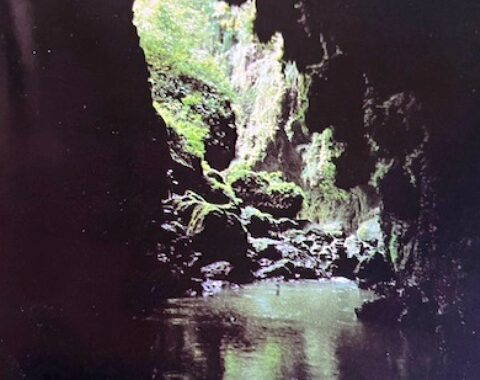
When I first glimpsed a shadowy cave entrance from the rim of Tres Pueblos Sinkhole in the early 1980s, the Camuy, though known to speleologists, remained little known to the public-at-large. I was fortunate to be able to explore several small portions of the system. On my debut trip, I went with members of the Speleological Society of Puerto Rico. Prepared with hard hats, life jackets, and three light sources, we descended the sinkhole and passed through a long toothy mouth of blackened rock. Once inside, we swam up narrow canyons and across small lakes, then, soaking wet, climbed up, down, and over slopes, precipices, and rocks. In the flickering light, I felt like part of a primeval religious procession; when we turned off the flashlights, we were surrounded by stunning silent blackness. We passed the cathedral beauty of a second sinkhole, the immense Big Room, a disorienting bridge of boulders, and scalloped rimstone pools, which seemed the exquisite abode of elves and fairies. The caves actually house more mundane creatures — dozens of insect species and millions of bats.
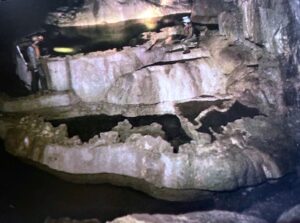
In 1987, the Puerto Rican government opened the Parque Nacional de las Cavernas del Río Camuy (Río Camuy Cave Park). By tram and on foot, the public can descend into a lush sinkhole, tour a penumbral cave with beautifully lit stalactites and stalagmites, and look down at the river below. The tours have been immensely popular, enabling hundreds of thousands to view the caves.
If you go:
Due to the caves’ fragile nature, the park has often closed over the years. It closed after Hurricane María and is undoubtedly closed for the coronavirus. Check before you go. If you do go, plan to get there early to ensure a tour. There are also groups that will take you caving through portions of the park. Research your group well. With potential flash flooding and other dangers, you want a group that will make your exploration memorable . . . in a good way!