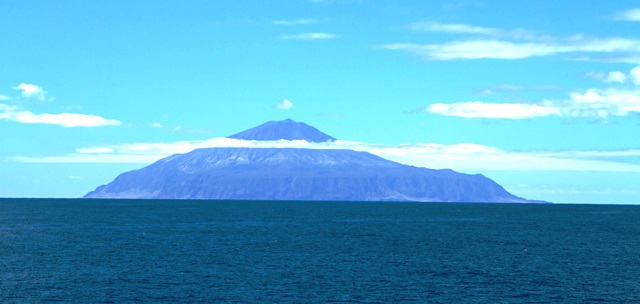
After I wrote the story about the man on Saba for my last post, I thought more about the urge to search out places that are remote in the extreme. Why do some people have that urge? Where are these places, and what are they like? Although I’d be hard-pressed to answer the ‘why,’ it took little effort on my part to learn the ‘where’ and ‘what.’ The two places that vie for the most remote places on Earth are the islands of Tristan da Cunha and Bouvet.

Tristan Settlement, courtesy Brian Gratwicke from DC, USA
Formation:
Imagine a time millions of years ago as tectonic plates shuffled continents into their current positions. South America and Africa detached and separated, and hotspots developed in the remote South Atlantic. Volcanoes rose above the ocean, erupting in fiery splendor in the nighttime sky and forming these two lonely, far-flung islands.
Tristan da Cunha, true isolation:

Tristan, courtesy Brian Gratwicke
Tristan da Cunha is billed as the most remote inhabited place on Earth. How remote is it? Here are the statistics – it lies 1,743 miles west of Cape Town, South Africa; 1,509 miles south of Saint Helena, an island isolated enough to hold Napoleon in exile; and 2,424 miles east of the Falkland Islands (which are 300 miles east of the South America’s Patagonia). The island is seven and a half miles in diameter, and its peak rises 6,750 feet above sea level. It is surrounded by several smaller uninhabited islands.
A bit of history:

Tristan potato patches, courtesy Brian Gratwicke
First discovered by the Portuguese sailor Tristao da Cunha in 1506, the island was known to international trade ships on their route back to the Old World, and to US whale and seal hunters. In the early 1800s, it became a British garrison. Due to the lack of a natural harbor, scant arable land, and a harsh climate – although not as cold as I would have thought, with average temperatures ranging from 49 to 70 degrees Fahrenheit, the island does get a lot of rain and constant winds – few people could survive here. All of today’s residents descend from seven surnames of original settlers who came to the island in the 1800s from Scotland, the US, Italy, South Africa, and other countries. In 1961, an eruption of Tristan’s volcanic peak resulted in earthquakes and landslides. Residents were evacuated to England. Though expected to remain in England permanently, the hardy islanders defied expectations, and most returned to Tristan in 1963.
Tristan today:
A British Overseas Territory, Tristan is home to some 250 citizens who reside on a lip of land that juts out from the base of the volcano, in a community officially named Edinburgh of the Seven Seas but referred to by locals as The Settlement. Here are the usual churches, hospitals, schools, and shops as well as a golf club and a scientific monitoring station. Residents are resilient, and the community is self-sufficient through subsistence farming and some commercial fishing. Land is communally owned, and no outsiders are allowed to buy land or settle on Tristan. A scattering of tourists visit each year (but not right now with the pandemic), arriving from Cape Town by commercial or cruise ship, hiking to peaks and ponds, viewing the unique flora and fauna, and ending the day with a drink at the Albatross Bar.
Bouvet Island:

Courtesy Andre NARE (Norwegian Antarctic research Expedition) 1978-79
Travel some 1,400 miles southeast from Tristan and you will come upon Bouvet Island, the most remote uninhabited place on Earth. It is slightly more than a thousand miles north of Antarctica, but still plenty cold. Its landmass – 5.9 by 4.3 miles – consists of an inactive volcano and cliffs up to 1,600 feet high, virtually all covered by a glacier. Only one place, created by a rock slide in the 1950s and home to an automated meteorological station, offers (highly dangerous) access to Bouvet. A French naval officer, Bouvet, discovered the island in 1739, but wrote down the wrong coordinates, and it wasn’t rediscovered, by the British, until 1825. A century later, several Norwegian expeditions made extended stays here, and Bouvet became a Norwegian dependency. In 1971, the island and surrounding water were declared a nature reserve, sheltering seabirds, penguins, seals, fish, and such flora as fungi and mosses.
Two Bouvet mysteries:
First, a phantom island: Some 40 miles from Bouvet, Thompson Island was sighted at least twice in the 1800s and placed on maritime maps as recently as 1943. However, it no longer exists: possibly, it disappeared in a volcanic eruption, but the depth of the ocean there makes that theory all but impossible. Or it never existed, a ghost island to travel-weary sailors. Second, a crewless lifeboat: In the 1960s, a lifeboat was found abandoned by the rock slide: though the boat was loaded with supplies, no crew members were ever found. Hmmm . . .
You’ve made these places sound very interesting. Fertile ground for the stories to come! Kate
On Sun, May 9, 2021, 10:20 AM Tree Ferns and Snow Globes wrote:
> Tree Ferns and Snow Globes posted: “After I wrote the story about the man > on Saba for my last post, I thought more about the urge to search out > places that are remote in the extreme. Why do some people have that urge? > Where are these places, and what are they like? Although I’d be hard-pre” >
Thank you! Such isolation could give you great peace — or desperation!