Author’s note: To get the most out of this story, first read the previous blog about the place. Thanks!
At times, the places I visit have stories far better than any I could concoct. Crete is one of them. Let us go back in time, far back, to the dawn of civilization, when legendary Greek gods, heroes, and creatures reigned over mere mortals.
In an origin story, the Greek God, Zeus, is born in a cave in east-central Crete. His mother gives birth there so his father, Cronus, won’t swallow him, as he has done his siblings in order to negate a prophesy that a son will dethrone him. Zeus survives and does eventually kill Cronus. Ah well. Cronus then regurgitates the other siblings, who, along with Zeus become known as the Olympians.
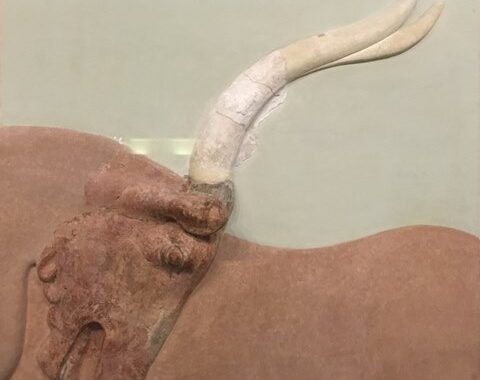
Fast-forward to Zeus as a man. Wandering through a land called Phoenicia, he falls in love with Europa, mortal daughter of a king. Changing into a white bull—he is a god, after all—he convinces Europa to climb on his back and whisks her to Crete. There, under a tree at Gortyna, he deflowers her. Eventually, this union produces three half-god sons – Minos, Rhadamanthys, and Sarpedon.
Fast-forward again, to King Minos as a man, now a mighty king and great warrior. He seems to have everything – a splendid labyrinthine palace at Knossos, built for him by the legendary architect, Daedalus; a beautiful wife, Pasiphae; and at least three lovely children, Androgeus, Ariadne, and Phaedra. However, he is a harsh ruler, feared more than he is liked.
One day, a magnificent white bull appears at Knossos. The god Poseidon tells the king to sacrifice it in his name. Quite taken by the animal, Minos instead sacrifices an inferior bull. Enraged by the deception, Poseidon punishes Minos by making his wife fall in love with the bull. Helped by Daedalus, she mates with it and gives birth to a creature with the head of a bull and the body of a man – the Minotaur.
Here we go on a slight tangent. Minos, furious with Daedalus, imprisons him in a tower at Knossos. However, the brilliant architect escapes by fashioning wood, wax, and feathers into wings for himself and his son, Icarus, to fly away. “Don’t fly too close to the sun,” he warns Icarus, but of course the boy in his youthful enthusiasm does just that: the wings melt, and he falls to his death.
Meanwhile, the Minotaur grows into a flesh-eating monster, and King Minos keeps him in the labyrinth beneath the palace. After his son Androgeus gets killed in a battle with the city of Athens, the grief-stricken father demands Athenian youth be sacrificed to the Minotaur. Prince Theseus, son of King Aegeus of Athens, volunteers to go to as one of the youth in order to slay the Minotaur. Before he leaves, he promises his anxious father he will change his ship’s black sails to white on the return voyage to show he is alive, his mission accomplished.
At Knossos, King Minos’s daughter, Ariadne, falls in love at first sight with Theseus. After obtaining a promise the prince will marry her, she gives him a ball of magic twine, with which Theseus finds the Minotaur in the maze, slays it, and escapes with the other Athenians. Theseus takes Ariadne with him when he leaves Crete, but he abandons her halfway home. Furious, Ariadne calls to the gods for vengeance. They comply. On arriving home, Theseus forgets to change the ship’s sails from black to white. King Aegeus sees the black sails and, in his grief, drowns himself in the sea. To this day, that stretch of sea is known as the Aegean.
Ariadne’s revenge isn’t over: Theseus marries. His first wife dies, and he remarries – Ariadne’s sister, Phaedra, of all people. Phaedra is jealous of Hippolytus, Theseus’s son by his first marriage. She accuses the son of attacking her; enraged, Theseus asks Poseidon to exact revenge on the young man. One day, when Hippolytus is driving a chariot along the beach, Poseidon creates a huge wave which scares the horses, causing the chariot to crash, killing his son. When Theseus discovers Phaedra lied to him about the attack, he is, understandably, livid. To avoid his retribution, Phaedra hangs herself.
Sense a pattern? Fury and revenge, revenge and fury – are there any happy endings in Greek mythology?
Much of this story can be found in the article, The Legend of Kind Minos by Louisa Watson at https://www.makrigialos.com/?article=minos
I like your stories better
Sent from my iPhone
<
div dir=”ltr”>
<
blockquote type=”cite”>
Thank you, though I can’t take credit for the convoluted plot of this one!