Author’s note: To most appreciate the story, first read the previous blog about the place. Thanks!
Once upon a time, 1334 AD to be exact, a girl was born to two Castilian nobles in the northern reaches of the Iberian Peninsula. Her name was María de Padilla. As a child, she led a comfortable life and grew into a beautiful, smart, and petite young woman.
One day the king passed through the region to do battle with his half-brother, Henry. María was scarce eighteen years of age. The king, Pedro I, was nineteen. He had worn the crown since he was sixteen, when his father, Alfonso XI, died of the Black Death, an illness that also claimed the life of his first fiancé. When they met, Pedro fell head-over-heels in love with María, and, as he was a handsome lad—pale, with blue eyes and blond hair, tall and well-built; well-read, a patron of the arts, and fond of the ladies—she reciprocated his love. Alas, he had already been coerced into another betrothal to a woman named Blanche, a marriage of mutual advantage but no passion. (As an aside, that marriage lasted only three days, when Pedro discovered his betrothed was having an affair with one of his numerous bastard brothers. Ah well.)
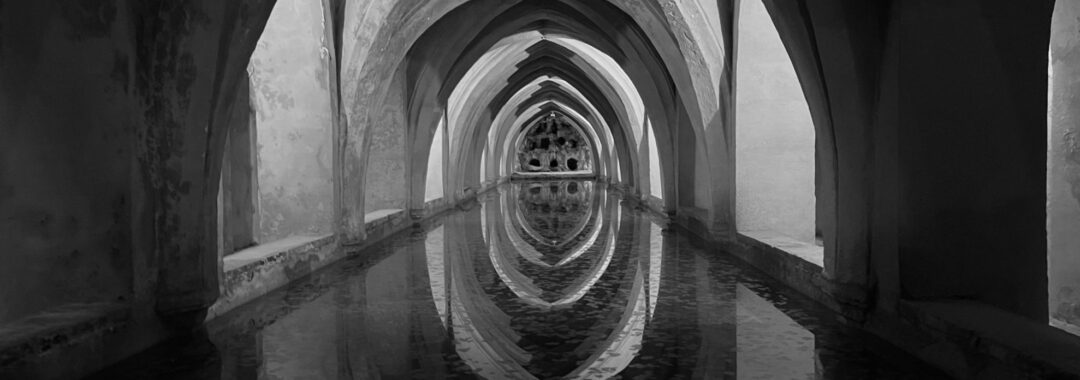
Pedro remained in love with María, and the couple lived, well, perhaps not entirely happily, but at least ever after. In spite of the disapproval of the royal court, which was very powerful at the time, Pedro established María as his mistress in the royal residence at the Alcázar. There she held court and advised the king. The summers were hot, and she liked nothing better than to walk naked to the baths and luxuriate in the cool waters. That, at least, is what the gossipers said, and the gossip eventually passed into legend.
The years went by. The couple had three daughters and a son. Pedro underwent another arranged marriage but deserted that wife after two nights. Time enough, it seems, for her to bear him another son. The king became known as a sympathizer to the Jews and the Muslims, and at one point he sided with the ruler of the Islamic kingdom in Granada. These actions did not gain him favor with the royal court. He earned his moniker “the Cruel” because he executed many of those vying for the crown, particularly within his own family, and was quick to exact revenge. But through it all, María remained at his side as mistress at the Alcázar.
When just twenty-seven years of age, María died, perhaps another victim of a plague. Pedro officially declared her to be his first and only wife, cancelling his two previous marriages and legitimizing the births of their four children. He declared their son crown prince, but the boy, a sickly child, died months later at the age of three.
Life spiraled downward for Pedro after María’s death. His first wife, Blanche, also died, and rumors circulated that he’d had her killed so she couldn’t contest the annulment of their marriage. Battles over the crown continued until Pedro was killed in 1369 by his half-brother, Henry, whom he’d been fighting when he met María. He was only thirty-four. (As another aside, some believed the royal court backed Henry II against Pedro I because Henry was weaker and thus more easily molded.)
María was initially interred in a monastery she had founded, but Pedro had her remains moved to the Royal Chapel of the Cathedral of Seville, where he joined her after his death—a fitting end to one of the great romances in the tumultuous times of the early Spanish monarchs.