For years, I’d wanted to return to Spain, where I spent my college junior year abroad. After several aborted efforts, my husband and I finally arrived in May, 2024. Our itinerary—to spend a week in Seville with Road Scholar, then rent a car and make our way deeper into Andalusia and up through the more traditional, less touristy Estremadura region. In a book about Seville, I found a stunning photograph of a pool in shadow under vaulted ceilings, and I vowed to visit it. Known as Los Baños (baths) de Doña María de Padilla, it lies half-hidden in Seville’s Real Alcázar.
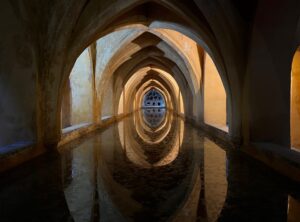
Los Baños de Doña María de Padilla
First, Seville:

Seville
Seville is a lovely historic city, a rich mix of the Muslim, Christian, and Jewish cultures that shaped its past. In the old quarters, narrow winding streets lead to cathedrals and churches, museums and archives, parks and gardens, tapas restaurants and flamenco tablaos. The navigable Río Guadalquivir runs though the city, and its intimate size, compared, say, to Madrid or Barcelona, makes it pleasant to navigate. Among the city’s crown jewels is the Real Alcázar, a sumptuous royal palace dating back to the time of Islamic rule. A UNESCO World Heritage Site, it is also the oldest royal palace in Europe still in use today.
Layers of history:

Seville’s Cathedral
Under a wall of the Alcázar (an Islamic word for castle/palace), archaeologists recently excavated remains dating back to the eighth century BC, perhaps belonging to indigenous Iberians. Centuries later, Romans invaded the peninsula, and after their decline Visogoths conquered from the north, building a Christian basilica on the ancient remains. In the 700s, the more powerful Arab and Berber Muslims invaded from the south, giving rise to al-Andalus and 800 years of an Islamic reign in which science, arts, and architecture flourished. At the site of the Christian basilica, the Muslims built a citadel that, over the centuries, expanded into a complex of courtyards, palaces, and a grand mosque. When the Christians captured Seville in the thirteenth century, the mosque became today’s cathedral, and the palaces got a Christian makeover.
Mudéjar: the Best of Both Worlds:

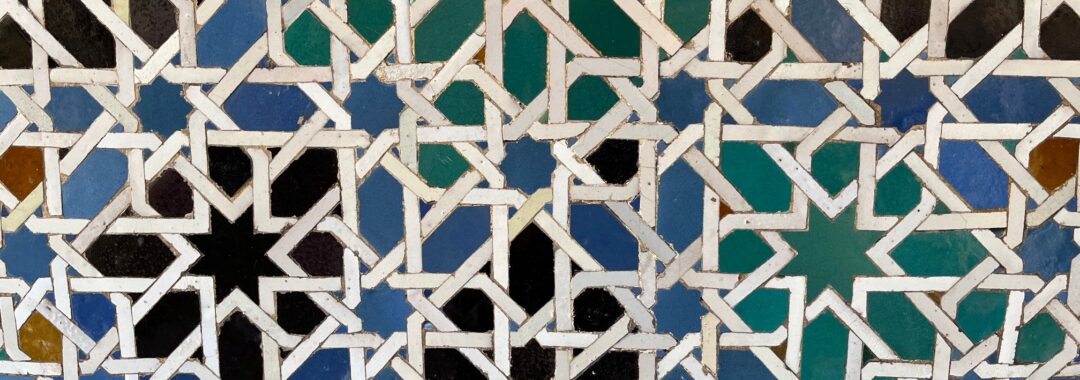
Mosaic
Not all Muslims left when the Christians began to reconquer Spain. Those who remained behind were known as Mudéjares. Mudéjar craftsmen applied Islamic motifs and patterns—calligraphy, intricate geometry, plant shapes—to Christian styles of architecture, resulting in exquisite facades, walls, and ceilings. This harmonious merging of Muslim and Christian art came to an end in the early 1600s, when the Muslims were expelled from Spain as the Jews had been earlier. Some of the finest examples of Mudéjar art is found in the patios and halls of Seville’s Alcázar.
Into the Alcázar:

La Puerta del León
Visitors enter the palace through La Puerta del León (lion’s gate), then embark on a kaleidoscopic tour of beautiful courtyards, halls, and rooms designed over the centuries by master artisans fusing Islamic, Gothic, Renaissance, Baroque, and Romantic styles. Best-known of the courtyards, the Patio de las Doncellas (maidens) highlights a long pool, pruned trees, and intricate plasterwork, arches and geometric designs. The most lavish hall is the Salon de Embajadores (ambassadors), a gorgeous display of azulejos (glazed mosaic tiles), elaborate plasterwork, horseshoe arches, and a dome of carved and gilded interlaced wood. Outside the buildings, lush gardens invite the overheated sightseer to relax amid scented flowers and geometric landscaping. Those who can’t visit the Alcázar directly can glimpse its grandeur as the setting for the kingdom of Dorne in HBO’s Game of Thrones series.
The Baths:

Los Baños
Located in a subterranean gallery below the Patio del Crucero (cross-shaped), Los Baños de Doña María dates back to the Alcázar’s early years. The elongated pool was a cistern originally designed to store water. Once opened to the sky, it was later covered by a series of Gothic cross-ribbed vaults lit by openings in the floor above. The result is enchanting, and the legend of María walking naked through the palace to cool off in the pool doesn’t seem too farfetched. However, don’t fantasize about swimming there, as I did: its depth is measured in inches rather than feet. At the far end is a grotto of Italianate design.
The Main Protagonist:

Patio de las Doncellas
The Muslim royal court lived in the Alcázar’s numerous palaces until their defeat in 1248 AD. Over subsequent centuries, several kings oversaw the expansion of the site. Best known was King Pedro I, who created the heart of today’s palace as his royal residence. King Pedro was a controversial ruler, known by his enemies as Peter the Cruel, primarily because he killed many rivals including half a dozen step-brothers, and by his supporters as Peter the Just. He admired the Islamic legacy of architecture and ornamentation, hiring Mudéjares to produce some of the Alcázar’s most beautiful halls and courtyards. And he loved his mistress, María de Padilla, who lived with him in the Alcázar and for whom the baths are named. Many stories, some contradictory, surround the couple. I’ll piece them together for you next week.
So stay tuned!
[To view another spectacular example of Muslim-Christian architecture, visit my virtual blog on the Mezquita-Catedral in Córdoba, Spain.]