Author’s note: To get the most out of this story, I recommend you first read the previous blog about the place. Thanks!
Strogili Island, summer of 1641 B.C.
“I refuse to go!” Kitane kicked the flounces of her long skirt.
“You have no choice in the matter. We reserved seats on a ship to Kaptara. It leaves at dawn tomorrow.”
“Not fair!” Kitane wiped at tears slipping from her eyes. “None of my friends have to leave. Why do we?”
Her mother exhaled her impatience. “We’ve been through this countless times. Your father knows more about volcanoes than anyone on the island, and he fears ours could erupt at any time.”
“But my friends—”
“No more arguments.” Her mother’s brown eyes glinted anger. She tightened a shawl around breasts exposed in a low-cut blouse. “Think about what you want to take.”
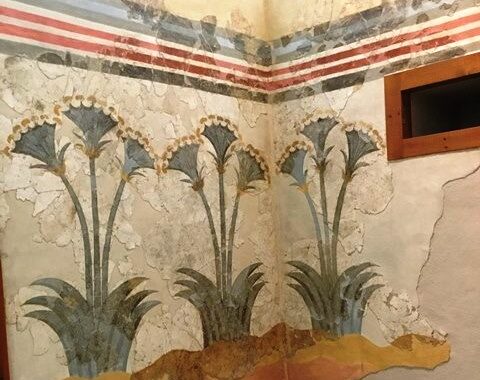
After her mother left, Kitane threw a large fabric satchel on her bed, then turned to a wall painted in flowers and glanced out a window. She could see the top of the volcano, its smoke rising.
**
For several months the volcano had been spewing gases and making rumbling noises. Most of the young people considered it an exciting novelty, not something to fear. One day, Kitane and several friends had walked to a cliff on the inner edge of the island. Sitting there, they could survey the entire island, shaped like a crooked ring around a huge disk of ocean. In the center rose the restless volcano.
Kitane thought of what her father had told her when she first saw the enclosed ocean. “Long, long ago, our volcano erupted in fire and ash, creating a crater that flooded with sea water. That is what you see.” He frowned. “It could happen again.”
One of Kitane’s friends, Yidini, had pointed to the top of the volcano. “Look at that.”
In point of fact, Yidini was more than a friend. He was tall and trim, elegant in his tunic and loincloth, and her heart beat faster when she was with him. They had recently kissed, and she couldn’t wait for them to do so again.
He’s not leaving Strogili, she’d fumed. His parents aren’t afraid of the volcano.
The others had looked in the direction of Yidini’s finger. “The volcano is different now,” he said. Earlier ejections had resembled steam rising from boiling water: now they resembled smoke rising from fire. The group had watched the smoke ascend and eventually disappear into the sky. They’d felt a shiver of anticipation.
**
In her room, Kitane impatiently crammed clothes and small mementoes into the satchel, including a copper bracelet Yidini had given her. She had to leave so much behind, and who knew when her family would return.
Last week, a farmer from the opposite side of the island had come to town. Her town, largest on the island with some 30,000 residents, was the center of trade to other islands. The farmer had arrived early to sell his goat cheeses and pressed olives. Sasha’s father approached him. “What news can you tell me of the volcano on your side of the island?” he asked.
The farmer set down his basket of goods. “Two nights ago my goats started bleating,” he began in a shaky voice. “Fearing a wild animal, I went to investigate. The sky was dark, but a small fire lit the side of the volcano. Below the fire, the earth seemed to be moving, as if it had melted and was sliding downward. I had never seen anything like it and was sore afraid.”
After that, her father had sprung into action. He returned with the farmer to confirm his story, then called meetings to urge the townspeople to evacuate. Most didn’t heed him. He booked passage on a ship sailing to Kaptara, a large island to the south, packed his most valuable treasures, and buried the rest.
The next morning, as the sky began to prepare itself for the new day in a wash of colors, Kitane, her younger brother, and her parents boarded a long wooden oar-and-sail-powered ship. Only ten other townspeople joined them. Yidini stood on the dock, waving forlornly.
This is not fair, Kitane thought for the umpteenth time, swatting away her tears.
Strogili Island, fall of 1641 B.C.
The departure of Kitane’s family and her father’s dire warnings disturbed the townspeople. After all, he was the volcano expert. But few acted on his warnings. Then one morning, streamers of fire and black clouds spewed from the volcano, spangling the sky. The scene mesmerized and terrified residents. They quickly crowded onto ships in their rush to leave the island. More ships arrived and more people left. Yidini’s’s family was one of them, and he made sure they boarded a ship bound for Kaptara. By the time winter arrived, with its cold, rainy weather, only a fraction of islanders remained. They kept two ships at port, packed and ready to sail if need be.
Strogili Island, spring of 1640 B.C.
The volcano erupted. Fire and plumes of smoke, ash, and gas roared toward the heavens, the upper volcano collapsed, and dark viscous matter slid down the remaining slopes. The eruption killed everyone on the island. Several families who had left on ships the day before got swallowed up by towering waves radiating from the volcano.
There were no survivors.