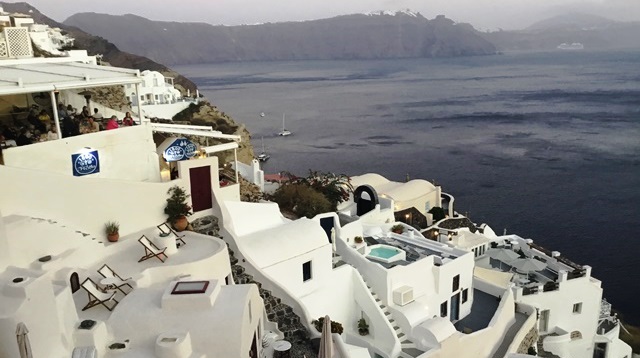
Before the ferry from Paros landed at the port of Athinios, our small group descended three stairways into the bowels of the ship. As we waited in dim light, the crowds got larger and denser, the enclosed area hotter. After what seemed an inordinate amount of time, a siren screeched through the air and a huge ramp slowly descended, giving the scene a dystopian feel. The narrow port squeezed against a massive cliff, a thousand feet high, that, somehow, we were going to ascend in a large passenger bus. In a series of zigzag turns best viewed with closed eyes, we reached the top of the island. Officially named Thera, for the Dorian King Theras, it is commonly known by the name Crusaders gave it for a local chapel to Saint Irene—Santorini.

Island of Santorini from the town of Fira.
Pompeii of the Aegean:
Four thousand years ago, a sophisticated Minoan town of perhaps 30,000 residents flourished on an island they called Strogili for its round shape. In approximately 1600 BC, a volcano in the center of the island erupted, spewing fire and ash, and drowning any survivors in a subsequent tsunami. A crescent island, today’s Santorini, remains above water, along with two smaller islands, and two remnant volcanic fragments in the center of a vast caldera.

Akrotiri excavation site.
Some 3,500 years later, in the 1800s, workers gathering up ash for the construction of the Suez Canal got a glimpse of this ancient Minoan town. It lies at the southern end of Santorini, where there is an open-air, roof-topped, ongoing excavation site known as Akrotiri. Walking on raised boardwalks, we looked down on a grid of masonry rubble, walls and window frames, beautiful large storage vases, beds on legs, bathing basins, and indoor toilets complete with sewage pipes. The main town of Fira showcases many of Akrotiri’s treasures in its Prehistoic Museum of Thera. Friezes display the spectacular colors preserved by the ash, and recreated homes reminded me of Frank Lloyd Wright architecture. I could live in one of them!
Into the Sunsets:

The village of Oia.
In Santorini’s most photographed village, Oia, interconnected whitewashed homes tumble down steep slopes on the northwest side of the caldera. An earthquake in 1956 rattled Santorini, destroying homes and buildings, particularly in Oia. Much of the village had to be reconstructed, which is perhaps why the homes here, some built cavelike into the cliffs, have a sculpted, fresh, and upscale look. Below a lovely blue-domed church, narrow alleyways wind around the homes, which today host shops, restaurants, and boutique hotels where rooms can go for upwards of $1,000 a night. We arrived in Oia in time to watch its renowned sunset. Along with claustrophobic hordes of tourists, we jockeyed for glimpses of the descending sun. I can’t imagine what viewing an Oia sunset would be like in high season. Not for the first time I wondered what the locals, now undoubtedly better off economically but at the loss of their ancestral homes, think of all this.
Around sunset the next day, we explored the streets of Fira. The town spans a larger portion of the upper cliffs, which means it has wider alleys, giving more room to stroll and stop to survey the spectacular caldera views. There are the usual shops and restaurants as well as churches, palaces, museums, small plazas, a monastery, and the Karavolades Stairs, almost 600 of them, that connect the town with Santorini’s old harbor. Tourists can opt to do the stairs by foot or donkey, a practice censured by animal lovers everywhere, or reach the harbor by cable car.
Tenacious Grapes:

Grape vines.
In spite of dry, windy weather, with scarcely any rain for most of the year, Santorini grows dozens of grape varietals and produces excellent wines. The hardy grape shrubs look like none I’ve ever seen — low to the ground and coiled up like Christmas wreaths. Such pruning protects the grapes from the wind and enables them to make the most of morning dew. We visited the Koutsogiannopoulos Winery, set in the center of the island. After tasting pleasing white, red, and dessert red wines, we ventured into the family’s wine museum, a fascinating labor of love that features human-sized dioramas and memorabilia about wines and wine makers, all set in a cave labyrinth some 900 feet long.
On the Mountain:

Atop the village of Pyrgos.
Inland, away from the edge of the cliffs, life on Santorini retains more of its traditional past. On our last day, we drove to the top of Mount Profitis Ilias (Prophet Elijah) to an 18th-century monastery of the same name. The site features a museum, bell tower, churches and chapel, but the still-active monastery itself is closed to the public. One of the small chapels is dimly lit and richly furnished with an altar, large chandelier, wooden chairs, thin candles, incense holders, and many icons lined in rows. Views from this, Santorini’s highest peak, were hazy that morning. Halfway down the mountain sits the village of Pyrgos. Not as commercialized as other towns we visited, it nevertheless has shops lining a maze of alleys leading to a well preserved Venetian castle, a former monastery expanded after the arrival of the Venetians in the early 13th century.
Along the Beach:

Perissa’s black beach.
On the southeastern edge of the island, modern homes and hotels in the town of Perissa soon give way to a long strip of a rich black-lava beach, where the deep-blue Aegean forms arcs of silvery foam in the sand. In summer months, Perissa’s beach is packed with tourists making use of a full array of beach facilities, but when we were there only a few beachgoers remained. Though the water beckoned, the air was chilly, and I opted instead to sit at a beachside table and enjoy our best seafood meal of the trip—a mixed grill of local sea bream, oversized shrimp, octopus, conch, and mussels. Sated, we then boarded the bus and returned to the port of Athinios.
After reading your travelogue
Kathryn, I think you are reincarnated from a temple priestess of classical Greece…..your words literally carried me to the island. I await your fictional reprise of Santorini, perhaps from the days before the caldera exploded…….
A shrewd guess . . .