Author’s note: To get the most out of this story, I recommend you first read the previous blog about the place. Thanks!
We had been sitting around a fire in a log cabin near Banff, Canada, celebrating Nammy’s ninetieth birthday. This was fifteen years ago. Of course she’d been the star attraction — seated in a plush armchair close to the fire, wrapped in several blankets, a wool band partially covering her sparse white hair. I’d just asked how she met my grandfather, then dead for many years.
“I would have died if it hadn’t been for your grandfather.”
The reply surprised all of us.
“Left to a spinster’s death of unrelieved boredom, no doubt.” My father, her only child, felt the need to inject flippancy into everything he said. He died last year. In fact, of the seven who attended Jan McMurray’s ninetieth birthday celebration all those years ago in Banff, only three are still alive.
“I’m serious, Jeffrey.” Her annoyed tone silenced all of us.
The fire crackled and popped.
“I came close to death that day. If Gareth hadn’t come along when he did, I don’t know what would have happened.”
My dad’s eyebrows puckered together. “How come I’ve never heard this story?”
Nammy’s shoulders twitched as she shook her head. “Ancient history. Caused me enough nightmares over the years. No sense chattering about it.”
“Will you tell us now?” I asked.
“Only if you promise never to bring the topic up again.”
All seven heads bobbed.
“Very well, then.” Her body settled deeper into the chair. “I was a nurse during the war.” Born in London, Nammy worked with the Army Nursing Service during World War II – we all knew that. “Mostly in Gibraltar, and I do mean in . . .” She closed her eyes.
**
. . . At dusk, when Janet Gwynn first set eyes on the Rock of Gibraltar from the deck of the HMS Cormorant, it reminded her of a supernatural fortress, its peaks rising like towers above an immense jagged hump. Fourteen hundred feet, they told her, but up close it seemed much higher.
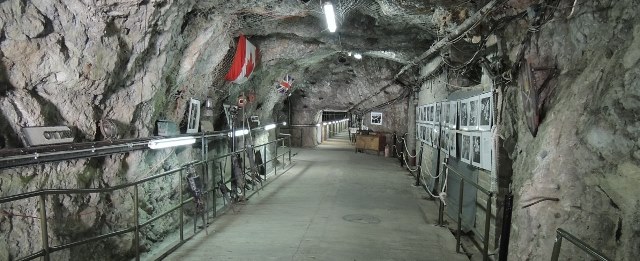
A soldier hustled Janet and several other nurses off the ship and into a rough-hewn gray tunnel lit by dim electric bulbs. The interior of the Rock held a maze of tunnels, more than thirty miles of them, according to the soldier, carved out of the soft limestone from north to south and east to west. Janet turned and soaked in the receding circle of blue sky at the tunnel entrance. Who knew when she would she enjoy sunny skies again . . .
They followed the soldier through numerous tunnels, identified by names of English streets. Some were wide enough for vehicles, he explained, while others served as bunkers for weapons and supplies, or were reinforced with half-cylindrical Nissen huts to hold offices, workshops, a hospital ward, mess halls, and sleeping quarters. “Also a water distillation plant, generating station, and frozen food storage. We can sustain 1,600 soldiers for up to 16 months.” He expected, and received, the nurses’ awe.
Their sleeping quarters, a grey room with bunkbeds and small chests of drawers, adjoined the hospital ward. “As soon as you settle,” the soldier told them, “they need you in there. Survivors of a ship blown up in the strait last night.”
Soldiers in various stages of injury were being cared for by one doctor and three nurses. For three hours, with scarcely time to breathe, Janet tended to broken arms and legs, applied compresses on burns, and offered comfort to young men screaming in pain and fear. When Dr. Rudolph asked for someone to get more bandages and syringes from a supply room, she gladly volunteered.
He rattled off a litany of street names interspersed with right and left turns that would take her to the supplies. “Got it?”
“Yes, sir.”
But she hadn’t. Almost immediately, she encountered tunnels with unfamiliar names, and crossroads that offered too many choices. Before long, she was lost, hopelessly lost, in what seemed to be a remote section of the labyrinth.
Janet noticed a room with a metal door ajar. Hoping it would be an office with a telephone, she entered and made her way down a long hallway.
Suddenly, she heard the sound of a faraway click. The hallway plunged into blackness, followed by the screeching sound of a metal door being shut. Paralyzed with fear, Janet could only scream for help. In answer, silence pulsed around her, darkness pressed in.
For what seemed an eternity, and was actually two days, she sat in the blackness, her stomach empty, her throat parched. Periodically, she let out a shout that sounded like a dying car horn. She thought of her parents, her younger brother, the beau she left behind. What a terrible way to die.
When all seemed lost, a brilliant shaft of light pierced the blackness, illuminating the silhouette of a soldier. He stepped in.
“Help,” she croaked.
“Criminy! I thought I’d heard a bird.” A light clicked on. Shielding her eyes from the bulb, she looked up at a handsome young man, smartly dressed in a Canadian uniform. The name engraved on his pocket was Gareth McMurray.
She spent the next two days recovering in the hospital ward. Though she asked repeatedly, no one seemed to know of the hallway with the metal door. Periodically, she would look for it, but it seemed to have vanished.
Janet served with distinction during the war. When it was over, she and Gareth married and moved to Canada. Decades later, he told her of Operation Tracer, a top-secret project to establish an observation post that would continue to function – sealing six volunteers inside the cave – in the event Nazis captured Gibraltar. During a pause in construction, a careless engineer had left the entrance door open and, after Janet stumbled in, returned to close it. When Gareth, also part of the project, was taking exercise in the tunnels, he heard what he thought were bird cries and went to investigate.
**
Nanny pressed her hands together against her chest. “And that’s how your grandfather saved my life.”