Author’s note: To get the most out of this story, I recommend you first read the previous blog about the place. Thanks!
How the city got its name:
After the California gold rush enticed hundreds of thousands of gold-crazy prospectors to the California territory in the mid-1800s and before the Klondike gold rush brought another hundred thousand to the Canadian Yukon at the end of the century, the northern stretch of the Inside Passage along the Gastineau Channel had its own more modest but perhaps more enduring gold-mining story. This is roughly what happened (and it’s better than anything I could have invented):
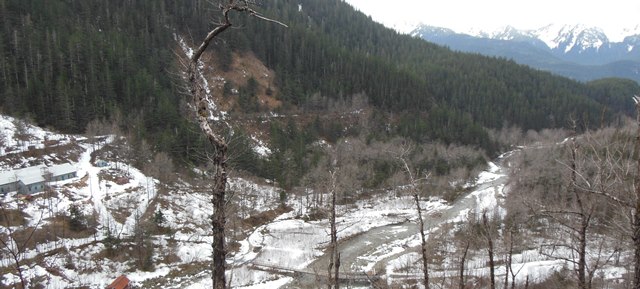
Inspired by the California Gold Rush, prospectors scoured southeast Alaska for more gold deposits. Among the enthusiasts was George Pilz, a mining engineer in Sitka, a former Russian settlement on an island in the Alexander Archipelago along the southern Alaskan panhandle. Reckoning that the local Tlingits might have an idea where to find the ore since they hunted and fished in the region, Pilz offered a reward of 100 blankets to any Tlingit who could lead him to gold-bearing ore. When Chief Kowee of the Auke Tlingit tribe came forth with gold samples from the Gastineau Channel north of Sitka, Pilz grubstaked prospectors Richard T. Harris and Joseph Juneau to investigate. In August, 1880, the two sampled gravel along a creek they called Gold Creek. They found specks of gold, but, whether due to sluggishness or cluelessness, did not persevere up the creek and returned to Sitka empty-handed. Once again Chief Kowee went to Pilz and urged him to return to the site. This time the two prospectors reached the head of the creek and found the mother lode. Their discovery led to the founding of the first town in Alaska after the U.S. purchased it. A mining camp rose up on the beach, with tents and shacks built from the abundant local trees and supplies brought in from Sitka. A U.S. Navy detachment was sent in to maintain order.
What to name the town? Harris, who wrote up the stake (apparently Juneau couldn’t read in English) decided Harrisburg had a nice ring to it. At a town meeting months later, the miners decided there were already too many towns named Harrisburg and decided to honor the Navy commander, Charles Rockwell, by naming the town Rockwell. This lasted until Juneau, complaining that nothing had been named after him, lobbied support for his name. The town became, and remained, Juneau.
Of course, the town should have been named after the true discoverer of the gold ore, Chief Kowee. Kowee, Alaska . . . Now that has a nice ring to it.
What happened to the protagonists in the founding of Juneau? Joe Juneau, inspired by his success, headed to the Klondike gold rush in 1897 and died there six years later. Richard Harris lost most of his holdings and had to work for local mining companies. He died in an Oregon sanitarium in 1907. Chief Kowee, who received virtually no credit for his role in the Juneau gold rush, died in the town’s Indian Village in 1892. Both Juneau and Harris were buried in the local Evergreen Cemetery. Chief Kowee, not permitted to be buried in the cemetery, was cremated and laid to rest at the entrance, where a bronze plaque has been erected.
[Most of the information here came from several sources recounting the early history of Juneau, including the Travel Juneau website.]
Did Kowee ever get his blankets? How did the town ever become the capital? I have questions. Thanks for the story.
Here’s my latest story. http://randyhaglund.com/stories/elvis-has-left-the-stadium/