Author’s note: To most appreciate this story, first read the previous blog about the place. Thanks!
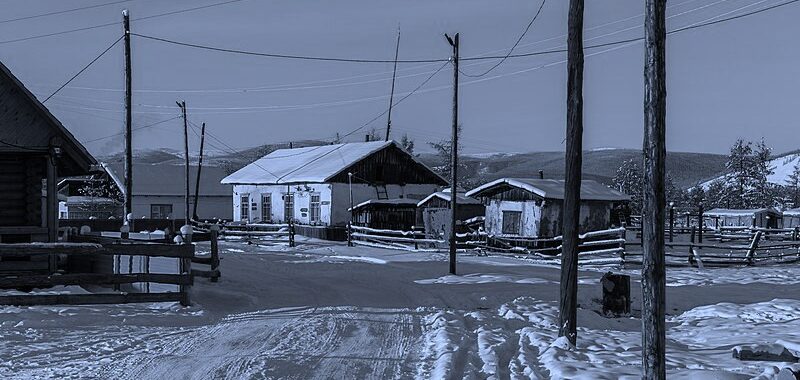
One day in early spring, when the temperatures began to poke above minus twenty degrees Fahrenheit, a stranger appeared in the village of Oymyakon. He rented an abandoned home on the village outskirts from the previous owner’s brother; the owner himself had departed for the warmer environs of Lake Baikal. The brother also sold him one of his rugged Yakutian horses. The wooden house was larger than most in Oymyakon, and villagers wondered why a single man would want to rent so much space, all of which would need to be heated year-round.
They eventually found out.
The man spoke the native language with a thick accent that wasn’t Russian. In spite of numerous inquiries, he never told anyone where he was from. Tall and massively built, he had a thick reddish-brown beard, small eyes, and a large mole on his nose. The rest of his body was covered in arctic gear.
Several days after the Stranger’s arrival, a large wooden box arrived at his house in a taxi-van from Yakutsk. The next day an ice fisherman, bringing his catch to market, saw the Stranger strike out with a rifle in his hands.
“He’s a hunter,” the fisherman pronounced.
Indeed he was. Every day he hunted. Some days he scoured the larch woods scattered about the village, other days he headed into the mountains, and several times he ventured out on days-long exhibitions. He always brought back something—occasional small game but mostly wild horses, stray cattle, and, primarily, reindeer.
That the Stranger used his sophisticated rifles to poach on their territory did not sit well with the local reindeer hunters. In addition, most of them shared their kills with neighbors, but not the Stranger. “What could one person do with all that meat?” they asked.
One day, after the Stranger left with the horse and a makeshift sled piled with gear, a sure sign he would be gone overnight, several hunters stole over to his house for a peek through the windows. Inside were reindeer and horse heads mounted on plaques on the wall, and animals roaming the house. Stupefied, the villagers watched them. The animals didn’t move. Unaware of the art of taxidermy, they thought the Stranger had placed the animals under a magic spell. From that moment on, they gave the man a much wider berth.
Now, everyone in Oymyakon knew there was one animal that was sacred, a reindeer nicknamed the native word for ‘giant.’ A male, the Giant stood taller and lengthier than any other reindeer, and by a large amount. His antlers extended from his head like the scaffolding for a new house. In spite of his massive size, the Giant was swift, outrunning other reindeer on the taiga, and smart, vanishing from sight before a hunter could lift his firearm. Over the years, the desire to kill the Giant was replaced by a respect for him, and, more recently, a feeling that the Giant brought the village prosperity.
One afternoon in mid-winter, when darkness had overcome the village, the Stranger returned pulling a dead reindeer on his sled. A giant reindeer. The Giant. Smiling at his great good fortune in bagging such a magnificent specimen, he didn’t notice the villagers rushing toward him, spears and firearms at the ready. The Stranger scarcely escaped Oymyakon with his life, keeping the hunters back with the threat of his rifle, cutting the sled from his horse, and riding the horse across the valley. No one saw him or the horse again. Villagers brought torches to the Stranger’s house and burned it and the animals inside to the ground, much to the consternation of the owner’s brother.
Saddened and fearful over the death of the Giant, the villagers propped the deer’s frozen carcass over the ashes of the home. Snow covered it, creating a sculpture twice as large as the original animal. Villagers came to whisper their innermost secrets to the deceased Giant when they passed by the impromptu statue.
By mid-summer, the snow had melted in Oymyakon, everywhere but on the Giant, which remained an impressive, merinque-like statue on the outskirts of town. Children poked at the surface: the snow was hard, as if it had transformed into something else—milky quartz perhaps, or white opal or gypsum. Scientists came to examine the statue. “No,” they said, “it is none of those minerals.” People traveled from throughout the Sakha Republic and beyond to marvel at the miracle, and some of them stayed.
The village prospered.