Author’s note: To get the most out of this story, I recommend you first read the previous blog about the place. Thanks!
George picked his way along the bluff as the last rays of sunlight dimmed and the pastel sky faded. In the distance, gray fingers of the Loch Ard Gorge defied the Southern Ocean, enduring even after eons of pounding surf.
Choosing a spot free of brush, George set his backpack on the ground. He rummaged inside for an energy bar, pulled the water bottle from a side pocket, and sat next to the pack.
“Dinner,” he announced to no one. Alternating food and drink, he focused on the line separating the now-dark ocean with a sky only slightly lighter.
In mid-afternoon, George and his hiking buddies had reached the giant stack formations of the Twelve Apostles, end-of-the-line for the Great Ocean Walk. After years of vowing to do the trail one day, they’d finally flown to Melbourne from Sydney and took a bus to Apollo Bay, start of the walk—one hundred ten kilometers spread out over eight days. Eight days of following dirt paths, steps, and boardwalks. Of taking in remote pale-sand beaches, shrub-forested peninsulas, rolling waves, reef rocks, and koala bears, plus the occasional lighthouse, river, and kangaroo. While they waited for a bus to take them back to the start of the trail, they spoke eagerly of how they would celebrate in Apollo Bay.
All but George. The healthy simplicity of walking, eating, and sleeping amid spectacular views had drawn him to the natural world. The stresses in Sydney, of a job he didn’t like, a girlfriend who didn’t seem to like him, too many peopled living amid too much concrete—all that lessened in importance. Happy here, he wasn’t ready to go back.
“Let’s take one more night and walk to Loch Ard Gorge tomorrow,” he had suggested as they stood at the bus stop.
The others answered with groans and boos. “Are you kidding?” This from Jerome, his oldest friend. “No way. I’m famished. All I want is an ice-cold beer and a couple of burgers.”
So, they parted company. George didn’t mind, not entirely. His world was now even simpler—no need for conversation, no reminders of Sydney. After his modest dinner, he spread a ground cloth, unrolled his sleeping back, and crawled in. For evening entertainment, he watched a trillion stars until he fell asleep.
In the morning, the sun rose, and dazzling color returned to the landscape. The cliffs took on reddish hues, the peninsulas a deep green. Long, low clouds draped the ocean horizon. George ate his last energy bar, packed up, and started toward the gorge. He could now walk all day and not grow tired, and his pack, though it still bulged, weighed less. Invigorated, George took great gulps of unpolluted air and set off.
The outlines of the cliffs ahead resembled horseshoes, and surf battered a scattering of large boulders offshore. Overhead, clouds moved across the sky, followed by dark stormy masses. When George reached the Tom and Eva Lookout, rain sputtered in large drops. The wind turned fierce, and salt spray drenched him. He stepped onto the lookout platform, covered his pack with the ground cloth and slipped on a poncho.
The bay below was shoebox-shaped. It lined a narrow beach, and cliffs on both sides framed two massive pillars, all that remained of a famous arch that had collapsed a decade earlier. The pillars had been given the names of Tom Pierce and Eva Carmichael, according to a platform placard, the only survivors of a disastrous 1878 shipwreck. The Loch Ard, an iron clipper ship with 54 people on board, en route from England to Melbourne, had gotten caught in thick fog and foundered on the cliffs of Mutton Bird Island, partially visible from the platform.
Just such fog swept across the sea, then the outer tips of the gorge, the island, the pillars, and finally the cliff in front of George. It erased everything, but he could still hear the ocean rage and waves boom against the cliffs. Gale-force winds sounded like lifeguard whistles as they shrieked past him. The rain increased. He sorely regretted his decision to stay here another night.
A short walk led to the Loch Ard Gorge parking area. From there, he knew, steps descended to the beach, where overhangs and a cave could protect him. Walking quickly, he fought the wind and deluge and stepped carefully down the slick steps. Once on sand, he noticed the barely visible outline of a cave to his right. Inside, he flicked water off his poncho and gave thanks to be out of the wind and rain.
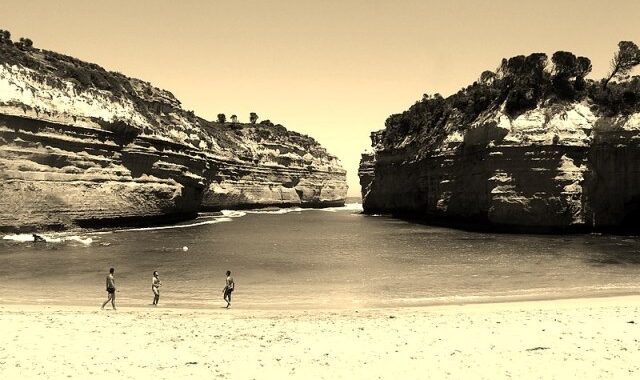
In spite of the shrieking storm, George nodded off. When he woke, the rain had slackened, and he could make out cliffs almost touching in the distance, forming an inverted V-shaped cove that widened into a pale-sand beach. Waves crashed against the cliffs.
On the beach, a boy flapped his arms wildly. He wore what looked like culottes and a vest, of a coarse and tattered muslin. His brown hair lay plastered to his face, his body shook, and his eyes bulged in terror.
George approached. “You’re shivering. Come into the cave,” he instructed. “Take off your clothes, and you can crawl into my sleeping bag.”
The boy’s eyes skidded from George to the ocean beyond the cliffs. “Were you on the ship?” His voice broke.
George felt a pounding in his head. A shipwreck? He saw no sign of one from the cove. The coast guard must be contacted, but there would be no signal here.
“No. I’ll go up to the cliffs, but first, come into the cave.”
The boy shook his head and turned to the water. George grabbed his wrist, and they struggled. “The ocean’s too rough. You’ll die out there. Tell me your name; let me help you.”
The boy went limp. “Thomas,” he said. “Thomas Pierce.”
[photo of Loch Ard Gorge, portengaround, Wikipedia Commons]