Ever since my husband and I moved to Spokane, Glacier National Park in nearby Montana has beckoned us with its stunning glacier-carved mountains, alpine lakes, and primeval forests. But it has also pushed us away. Our first reservation, at McDonald Lake Lodge in 2018, was canceled due to wildfires. The following year we stayed in Apgar Village and explored the western half of the park, taking the fabled, busy Going-to-the-Sun Road across the Continental Divide. Our reservations for the legendary Many Glacier Hotel on the park’s eastern border were cancelled in 2020 due to COVID. This past August we finally made it to Many Glacier but had to reach it by skirting the park: tickets to travel the Sun Road had sold out long before I realized we needed them. And crossing into the Canadian portion of the Waterton-Glacier International Peace Park remained closed, for humans at least.

Many Glacier Lodge, dwarfed by nature
The Alps of the Americas:
In the 1890s, the Great Northern Railway first crossed the Continental Divide at Las Marias Pass. Seeking to promote tourism in the region, particularly after Glacier became a national park in 1910, officials dubbed the mountains ‘the Alps of the Americas’ and built hotels modeled on Swiss architecture. The grandest is Many Glacier Hotel, a sweeping construction of dark wood chalets and windows overlooking a jaw-dropping panorama of lake and rugged peaks.

A room with a view
Long before:
Ten thousand years before European trappers came in search of furs and trade routes, Native Americans began to settle the region. Kalispell and Kootenai tribes settled west of the Divide. Later, in the early 1600s, the more aggressive Blackfeet people made claim to the eastern slopes, ‘the backbone of the world,’ to hunt buffalo, shelter from the bitter winter winds, and venerate spirits believed to inhabit the mountains. Today, the Flathead Reservation of the Confederated Salish and Kootenai Tribes lies west and south of the park, and the Blackfeet Nation borders the park on the east. Each of the reservations encompasses over a million acres of land.
The diminishing glaciers:
According to a park guide’s definition, an active glacier must be at least 25 acres in size, 100 feet deep, and in constant motion under its own weight. In 1850, early explorers identified more than 80 glaciers in the park. They were seeing them at the end of the last Little Ice Age. When temperatures are low, as in an ice age, the glaciers advance; when high, they retreat. Since 1850, temperatures have been rising and the park’s glaciers melting. Today, Glacier has only 25 active glaciers, and scientists predict all will be gone by 2050, if not before.

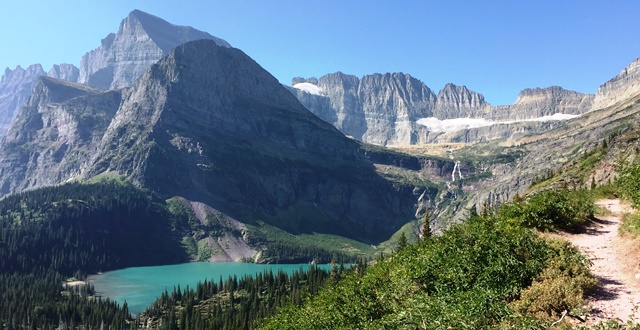
View of Grinnell Lake from the trail
A hike to Grinnell Glacier:
Urged on by a desire to stand next to a glacier before it retreated further, my husband and I embarked on the Trail to Grinnell Glacier our last full day at the park. Rated as very strenuous, it covers over 11 miles, with an elevation gain of 1600 feet and a few cliff-hanging stretches. It posed a challenge for someone who has a robust fear of heights (me) and broke her ankle eight months earlier. A ride on the park’s picturesque wooden boats across two lovely alpine lakes would have cut off four miles, but getting a last-minute reservation for the boats was futile. The trail skirted the lakes, then started its ascent. For a couple of miles, there were stunning ever-changing views down to mountain-rimmed Grinnell Lake, temporarily closed to humans due to bear activity. Mountain goats, bighorn sheep, and grizzly bears are the iconic animals in Glacier, but the sheer number of hikers on the trail that day made it unlikely we would see any, and we didn’t. The trail hugged a cliff face as it rounded a ridge, then headed higher. At a small rest area, I thought we’d arrived, but no—we had to stagger through an exhausting half-mile of steep, boulder-strewn moraine before our destination opened up in front of us.

At the glacier
The glacier:
The glacier, the lake, a mountain, and other sites in the park were named for George Bird Grinnell, an explorer/conservationist/writer who fell in love with the mountains and was instrumental in establishing them as a national park. Now approximately 150 acres in size, Grinnell Glacier has shrunk by almost half since 1966. The striated, gray Garden Wall rises above a massive slab of glacier to the left, and, to the right, a cloudy blue lake, catchment for the melting ice.
Was the hike worth it? Yes, with views that will stay in my mind’s eye for years to come.
I enjoyed your informative post and the (relatable!) account of your personal experiences there!
On Tue, Jan 18, 2022, 2:28 PM Tree Ferns and Snow Globes wrote:
> Tree Ferns and Snow Globes posted: “Ever since my husband and I moved to > Spokane, Glacier National Park in nearby Montana has beckoned us with its > stunning glacier-carved mountains, alpine lakes, and primeval forests. But > it has also pushed us away. Our first reservation, at McDonald Lake L” >
Thank you, Kate, my faithful reader!