Author’s note: To get the most out of this story, I recommend you first read the previous blog about the place. Thanks!
1820
Kimi woke to a dawn chill and fog on the lake. It was summer, and the chill would turn to mid-day heat. She lay under her hide blanket for several minutes, breathing in the crisp air. Daughter of the chief of a band of Blackfeet, Kimi had straight black hair secured in braids, a prominent nose, high cheekbones, and bronzed skin. It was an attractive face. She knew this, knew that she was blessed in other ways as well—beloved by her father and by Apisi, her promised husband, who was a brave and handsome warrior. Both men slept in the open nearby. They formed part of an expedition of five men and Kimi, crossing the mountains to ensure no enemy tribes were encroaching on Blackfeet land.
Kimi prepared breakfast for the men, a simple meal of berries and dried meat. When the sun peeked through the trunks of evergreen forest, they placed their blankets on the horses and mounted. After skirting two lakes linked by a fast-moving stream, they ascended through mountain meadows and around steep ridges. All around them rugged peaks created by the god Napio stood sentry over blue-green lakes and deep-green forests. Kimi felt fortunate to live amid such beauty. Giving thanks, she touched her beaded medicine bag filled with sacred sage. Given to her by her uncle, it was her most prized possession, the reason for her good fortune. In the distance, a mountain goat watched the procession.
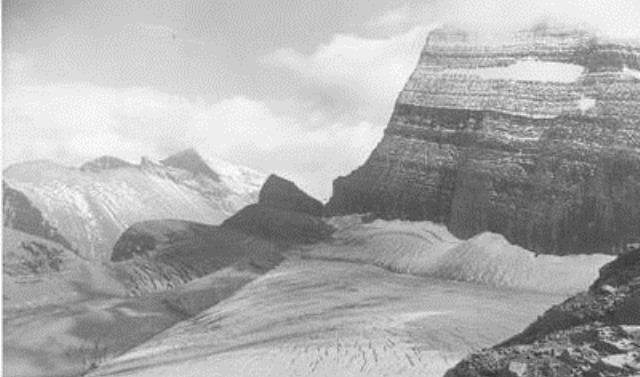
Soon they reached a vast expanse of white ice set against a massive curve of gray cliff. The horses picked their way across the ice. Hers came close to a rocky outcrop, and she had to push away to keep the rock from slashing her hide dress. Beyond the ice, gray clouds appeared above the peaks. “A storm approaches,” her father warned, “we must move quickly to shelter.”
It wasn’t until the Blackfeet reached their shelter that Kimi realized the beaded medicine bag was gone. Frantically, she checked her dress, the pack that contained food, and her blanket. Nothing. With Apisi, she retraced her steps partway down the mountain until rain, wind, and darkness forced them back. No bag. Fear clutched at Kimi’s heart, and she didn’t sleep at all that night.
The next day, warriors of an enemy tribe ambushed the Blackfeet party, slaughtered the five men and one woman, and stole their horses.
1915
Seventeen-year-old Eleanor dreaded the stay at the newly opened Many Glacier Lodge in the newly established Glacier National Park, as she dreaded most everything in her life. Her father, a wealthy member of New York’s upper-crust society, had given her no choice. He dictated the plain young woman’s every move since the death of her mother, by an overdose of pills, nine years earlier. Four years ago, he added sexual favors to his demands.
Why did no one at the lodge question a father and daughter sharing the same small room with a single double bed? She was powerless to do anything other than end her own life, which she had come close to accomplishing—twice.
Their last full day, they along with two guides hiked to a nearby glacier. The views were stunning, but they brought Eleanor no peace. If only she could run away and hide in the timeless mountains. Start a new life. But she could not survive, pampered as she’d been all her life. She straggled behind the others. When they reached the glacier — massive slabs of dirty, striated ice stretching over a mile — she wandered off. At the edge of the ice, a small lake held melting glacier water. A sparkle caught her eye. Moving closer, she discovered a leather pouch onto which small colored beads had been sewn in a geometric pattern. Leaning over, she retrieved the pouch and pried it open. A matted tangle of desiccated leaves—
“Eleanor, get over here!” her father shouted. “What do you think you’re doing? Trying to kill yourself again?” He ignored the shocked look of the guides. Eleanor slipped the pouch into her pocket.
Within days of their return to New York, her father was accused of a massive embezzlement scheme. Unable to rally support and post bail, he went to prison. The court found him guilty and sentenced him to ten years in prison, where he died after the second year. Most of the family wealth was confiscated, but Eleanor, pitied by the court, received enough money to sustain herself in comfort for the rest of her life. She never married, but lived an active happy life in a Manhattan apartment, surrounded by a small group of close friends. Much of her money went to charities, particularly those that helped the Indians of the western plains.
When asked how she had attained such peace in her life, Eleanor spoke of the mysterious ways in which fate worked.
[photo of Grinnell Glacier, T.J. Hileman]