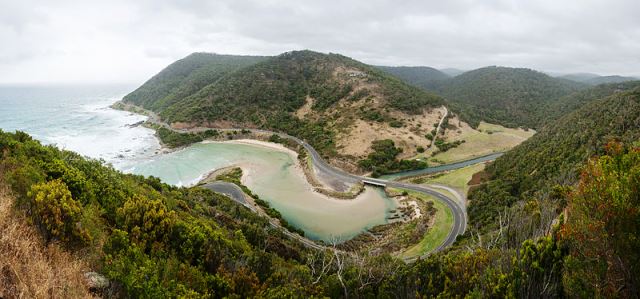
I took a personal interest in Australia decades ago, when college friends talked of emigrating there (they never did). It has always remained in my mind as a faraway place of immense skies and wide-open semi-desert landscapes linked by rough, straight, unending roads. If pressed to name three of the country’s top destinations, I’d list the Sydney Opera House, the Great Barrier Reef, and Uluru/Ayers Rock. Wanting to find something a bit more off the beaten path for this virtual journey, I did some research and came up with The Great Ocean Road along Australia’s south coast, overlooking the Southern Ocean in the state of Victoria.

The Great Ocean Road. Photo by Bobak Ha’Eri, Creative Commons.
The State:
Victoria nestles in the extreme southeastern sag of the continent, across the Bass Strait from Tasmania. It is the second smallest state in terms of land and the second largest in population. A gold rush in the mid-nineteenth century brought people and wealth to the region. Today, it is a diverse cultural hub, with numerous Aboriginal groups and large immigrant communities. Its capital, Melbourne, houses most of the state’s population. The second-largest city in Australia, it features museums and galleries, riverside bars and restaurants, and is dubbed by some as the world’s sporting capital, particularly for the Australian versions of cricket and football.
The World’s Largest War Memorial (or at least the longest):
At the end of World War I, a rugged stretch of coastline in southwest Victoria was accessible only by sea or rough bush tracks. At the same time, many soldiers returned from the war without jobs or prospects. Several men with a vision obtained funds to build a road here in order to connect isolated coastal settlements, increase logging and tourism, and provide employment for the returning servicemen. Some 3,000 men worked on the project, now known as the Great Ocean Road. Begun in 1919 and completed in 1932, hewn primarily by hand and extending some 150 miles, the route became a war memorial for the soldiers who died in the war.
Of Surfing and Shipwrecks:

Cape Otway Lighthouse. Photo by Dietmar Rabich, Creative Commons.
The road begins at the surfing town of Torquay, a three-hour drive from Melbourne. The first half of the route hugs the Surf Coast, where powerful winds sculpt the coastal water. Just beyond Torquay, the huge waves of Bells Beach make it Australia’s most famous surfing spot. At the midway point is Cape Otway. A side road detours through koala country to the dazzling white Cape Otway Lighthouse, perched on 300-foot cliffs. Beyond the cape, the road rambles along what is referred to as the Shipwreck Coast, a rugged landscape of towering limestone cliffs and deep gorges, with tales of several tragically famous shipwrecks out of hundreds that occurred here over the centuries. At Wreck Beach, anchors remain from two of them. The road winds through rainforest, cuts through picturesque seaside towns, and connects to pristine beaches, making this one of the most spectacular driving routes in the world.
Self-Driving the Route:

Coastline near Lorne. Photo by David Iliff, Creative Commons.
Though the Great Ocean Road may seem off-the-beaten-path from my armchair in Washington State, more than eight million people drive it every year, making for dense traffic on weekends and holidays. The road itself is two-laned and paved, with much winding and many twists. Numerous turn-offs enable faster drivers to speed onward, and slower ones to stop and breathe a sigh of relief. Most websites suggest taking at least three days to do the route justice.
Along the way:

Erskine Falls. Photo by Ari Moore, Creative Commons.
The ocean is always close at hand, but landscapes change. West of Torquay, the red-capped Split Point lighthouse shares an inlet with the village of Aireys. A short drive north from the town of Lorne is Erskine Falls, a 100-foot waterfall nestled in a tree-fern gully. This is part of the Great Otway National Park encompassing coastline, waterfalls, rainforest, California redwoods, koalas, paths, and picnic areas.

Twelve Apostles. Photo by Jess Miller, Creative Commons
Beyond Otway, limestone takes center stage. The most famous site here is the Twelve Apostles, a grouping of stacks up to 150-feet high that rise above the shallow coastal waters. Over the eons, wind and saltwater have eroded the limestone cliffs, resulting in caves, arches, pillars, and other formations. Originally referred to as the Sow and Pigs, the Apostles were renamed to give them greater respectability, in spite of the fact there were only nine stacks at the time, reduced to eight today. Go figure. Nearby, the spectacular Lock Ard Gorge, named for a local shipwreck, features blue waters, a pale-sand cove, and a massive archway that collapsed in recent years.

Joanna Beach campground. Photo by wanderingchina, Creative Commons.
The Twelve Apostles can also be reached from a trail that begins in Apollo Bay. Known as the Great Ocean Walk, it is almost 70 miles long, hugging the coastline and passing through two national parks. Eight days are recommended for the hike, and there are campgrounds along the way (reservations required) and fancy resorts nearby.
The route officially ends at the town of Allensford, but many drivers continue to the small city of Warrnambool. From either place, there are roads—faster, less winding, actual highways— leading back to the city of Geelong and from there to Melbourne. I imagine not too many drivers opt to turn around and take the Great Ocean Road back.
Another great travelogue. I read them all, as well as the accompanying stories.
Randy
Sent from my iPhone
>
Thanks so much, Randy. I appreciate your faithful interest!