Ah, the cruelties of the ever-evolving coronavirus! As it receded last year, I set my sights on traveling again, and the long-postponed trip to Spain began to take shape. The arrival of the omicron variant dashed those plans, pushing me back to virtual visits. Now there is renewed hope. Will it last? It seems in these troubling times we could profit from a dose of the holy, and what better place to find it than within the many religious layers of the Mezquita-Catedral in Córdoba, Spain.

Prayer Hall of the Mezquita-Catedral. Courtesy James Gordon.
The city of Córdoba:

Historic Córdoba. Courtesy Michel Wal.
First, the city itself. Of dubious distinction, Córdoba has the highest summer temperatures of any place in Europe, with average highs approaching 100 degrees in July and August. Populated by more than 300,000 residents, it is the third largest city in Spain’s southern Andalusian region and a great place to learn of the region’s iconic flamenco music and dance. A crossroad of cultures, this area saw waves of settlers—Neanderthals, Romans, Visogoths, Muslims, and Jews—before being conquered by Christians in 1236 and becoming part of Christian Castile. Under Roman and Muslim rule, the city flourished: in spite of almost a millennium of Christian influence, Córdoba remains a typically Moorish city of narrow winding streets and lush courtyards. Its architecture includes Roman bridges and columns, Muslim mosques and palaces, Christian monasteries and churches, and museums documenting it all. A popular tourist destination, Córdoba is also a mecca for textiles, medieval handicrafts, and gold and silver jewelry.
The Umayyads:

Courtyard of the Oranges. Courtesy Sharon Mollerus.
At one time, the Umayyad dynasty ruled the entire Islamic world from its capital in Damascus. When it was overthrown in the mid-700s, survivors established a new capital in Córdoba and strove to recreate the grandeur of the Near East on the Iberian Peninsula, constructing buildings and planting gardens. For hundreds of years, Córdoba, though under Muslim rule, tolerated Jewish and Christian communities, and the city reigned as a cosmopolitan world center for science, medicine, philosophy and invention during the Islamic Golden Age. In the late 900s, the Umayyad dynasty began to decline.
On holy ground:

Cathedral above the mosque. Courtesy Max Pixel.
Construction of the Mezquita began soon after Abd al-Rahman became the Umayyad caliph of Córdoba, in the late 700s, but it wasn’t the first center of worship on the site. In earlier times, a Roman temple stood there, and some of that ruin was said to have been used in building the mosque. After the temple, a Visigoth Christian church rose up on the site, which, for a time, was shared by both Christian and Muslim worshipers. In addition, the Jewish Quarter abutted the mosque. Over the centuries, the Mezquita became one of the largest and grandest mosques in Spain, rivaling those found in the Near East. After Christian Spain reconquered Córdoba in the thirteenth century, the Crown eventually built a cathedral in the center of the mosque and converted its minaret into a bell tower. Fortunately, much of the Muslim architecture remained intact.
A long-ago visit:

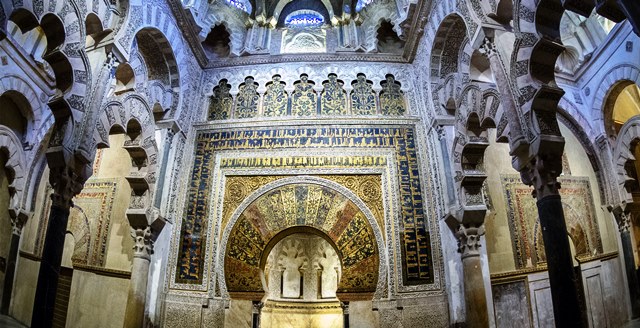
Mihrab inside the mosque. Courtesy Angel M Felicisimo.
Almost half a century ago during the year I studied in Spain, I visited Córdoba and spent an afternoon at the Mezquita-Catedral. The decades have blurred my memories of the lovely courtyard of orange trees originally planted by the Muslim caliphs; the bell tower, with details of the minaret still visible within its outer shell; the spectacularly decorated prayer niche (a mihrab pointing the way to Mecca, a maqsura screen, and a dome, done in mosaics of flowers, Koran inscriptions, and glittering gold); and the Renaissance cathedral, which underwent construction for more than two centuries. What does remain sharp in my mind is the mosque’s vast prayer hall and the sense of walking through a stunning geometric assemblage of tall columns and red-and-white striped arches that appeared to extend into infinity, a serene and spacious place of deep spiritual reverence. In fact, the mosque was built for that very purpose—to give the feeling of a simple, horizontal space in which to commune with God. At its pinnacle, it sprawled over 150,000 square feet and had 1,293 columns. 856 columns remain today, along with the feeling that visitors tread on holy ground.