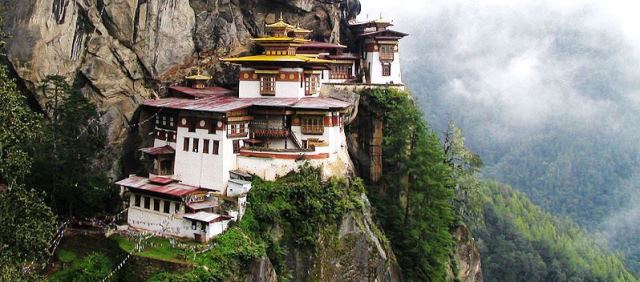
A large photo of Bhutan’s Tiger’s Nest monastery, also known as Paro Taktsang, hangs in my dermatologist’s office. Whenever I pass it, I get a tingle up my spine. The tingle comes in part from the dramatic beauty of the Buddhist temple and in part from its precarious position tacked onto a vertical granite cliff thousands of feet above a lush valley. ‘Yikes,’ my acrophobic mind cries out, ‘if I ever got up there, I’d never get down.’

Tiger’s Nest, courtesy Douglas J. McLaughlin
First, Bhutan

Bhutan landscape, courtesy Bernard Gagnon
The Buddhist Kingdom of Bhutan is a small, mountainous country wedged between China (specifically, Tibet) and India in the Eastern Himalayas. Fewer than a million people live in a rugged landscape of mountains, ravines, and valleys slightly smaller than Switzerland. Subtropical valleys in the south give way to temperate highlands, and in, the north, snowpacked peaks, including the world’s highest unscaled peak. People have lived here for at least four thousand years, primarily in a patchwork of independent fiefdoms until the early 1600s, when a Tibetan Buddhist lama named Ngawang Namgyal unified the region. His work didn’t last, and civil wars and skirmishes continued to the turn of the 20th century when Ugyen Wangchuck was declared hereditary king of a monarchy. Today, Bhutan is a constitutional monarchy with a parliament and a well-regarded king, and the country is known for its focus on protecting the environment and an emphasis on mental well-being over material success. Some call the country a living Eden, or a modern-day Shangri-La.
How the monastery came about

Guru Rinpoche, courtesy Carsten.nebal
Buddhism spread from India to the region of Bhutan in the first millennium. The Guru Rinpoche (a holy man of several names and manifestations) introduced Buddhism to Tibet in the 8th century and pilgrimaged to Bhutan, meditating in several of its caves. One of them, which he reached on the back of a tigress, is the site of today’s Tiger’s Nest. There he meditated for three years, three months, three days, and three hours to subdue demons in the cave. Fast forward nine hundred years to when Namgyal fled persecution in Tibet, established a base in Bhutan, unified the region, and created a cultural identity. So important was he that governors hid his death from the public for fifty years, claiming he was in meditative retreat, to avoid a return to warlords and fiefdoms, which eventually did happen. Namgyal wanted to build temples around the caves where Rinpoche had once meditated, and his successor, Tenzin Rabgye did so in the late 1600s. According to some legends, Tenzin Rabgye was a reincarnation of Rinpoche. The Tiger’s Nest is perhaps the best known of several such cave monasteries in Bhutan.
An impossible site

Tiger’s Nest, courtesy Vinayaraj
The monastery is near the town of Paro which is west of the capital city of Thimphu, in west-central Bhutan. Gray-hued slopes rise vertically some 3,000 feet. Stands of pine trees add greenery along the way. Paths lead to the caves from several directions. Workers dragged soil, stones, and timbers up the paths to build the monastery’s four main temples and residential buildings on the ledges, caves, and rocky terrain. What an engineering feat! Monks practicing Vajrayana Buddhism, Bhutan’s state religion, usually stay at the monastery for three years, recreating Rinpoche’s stay. The Tiger’s Nest temples are interconnected through narrow passages, rock steps and stairways, and a rickety wooden bridge or two. Images, paintings, and scriptures decorate the temples. The monastery resembles a fortress, with small windows, overhanging roofs, and, on top, golden pinnacles (sertoks).
The ascent
Can mere mortals reach the Tiger’s Nest and live to tell the tale? The answer, of great surprise to me, is a resounding ‘yes.’ The hike up to the monastery is very popular, and even Prince William and Kate made the trek on a recent visit to India, Bhutan’s neighbor and ally. But first, you have to enter the country. In order to do so, you must select a pre-paid, pre-planned, guided package tour that averages two to three hundred dollars a day. No unwashed hippies here. The cost is meant to restrict the number of tourists and help pay for the country’s conservation and social welfare programs.

Trail to Tiger’s Nest, courtesy Vinayaraj
The trail to Tiger’s Nest is four miles, round trip, with an elevation gain of some 1,700 feet to an altitude of 10,000 feet, and can take anywhere from three hours to a full day. It starts in the Paro Valley at the base of the cliff, and ascends, at first gradually, then more steeply and in zigzag fashion, amid trees, colorful prayers flags, and a prayer wheel. Restrooms and a small café lie at the halfway point. Some take horses or mules to this point, and many go no farther. Beyond, the trail continues up to a platform where the monastery can be seen across a valley and slightly below the hikers, who then descend, cross a flag-strewn bridge over a waterfall, and ascend what seems an infinite number of rock steps up to the monastery itself. At the entrance, belongings are stored, and no photos allowed. Monks give guided tours (so much for meditation), and then it’s back down to the valley. Some hikers claim to have a fear of heights but felt the vegetation along the trail made it doable.
I’m dubious.
Sounds like a place for you and John to visit….nice hike and surely there must be a Buddhist mystery story lurking in those caves……
RIchard
I’m afraid that hike will never be anything other than virtual. I couldn’t even make it up a canopy tower in El Yunque, and I was younger then. Stay tuned for the story!
Hi Kathryn, I enjoyed reading this very much. It’s nice lively writing and your personal comments add to the fun.
I paticularly liked knowing more about Bhutan…that little country has fascinated me since we came across their exhibit at the Smithsonian Folklife Festival on the grassy mall in Washington DC about a dozen years ago. I remember they had a house structure and lovely big posters, and several people who cheerfully told about their country and answered questions. A king who made it illegal to sell tobacco to his people sounded like the right sort of king to me! ~Kate
Thanks, Kate. Bhutan is intriguing — not perfect, as I learned in a couple of articles I read, but trying and in many ways succeeding in maintaining its culture and traditions. You have to admire that.