Author’s note: To get the most out of this story, I recommend you first read the previous blog about the place. Thanks!
Faial Island, 1750
Fia Andino stroked Theo’s muzzle. “I don’t want to sell you,” she told him in a soft voice. “But Mamá says we have to.”
As if understanding the words, the goat pulled its head back and stomped a hoof.
Fia didn’t try to stop the tears that trickled down her cheeks. For more than two years, Theo had been her responsibility. It was she who named him, filled his trough with water, and led him to pasture. He had become a friend, far easier to talk to than her infant brother Nico or her mother, María, who used all her words to complain about their ‘situation.’
It began a year ago, when her father walked down the mountain to the town of Horta for a job on a fishing boat. “I’ll be back in a month—two at most,” he promised, kissing María on her ever-growing belly and tousling Fia’s hair. He never came back. When María inquired at the dock, she learned the boat had returned—without her husband. Had he died of illness? Committed a crime? Fallen overboard? No one seemed to know. After the birth of little Nico, María turned bitter, certain Dmitris had abandoned his family for an easier life elsewhere.
That morning, María had slammed the door shut on their empty pantry. “Nothing!” she shouted. “That’s what your father has left us with.” Fia’s stomach grumbled, attesting to the lack of food. For months, their supplies of wheat, beans, and other staples had been dwindling. Now they were gone and winter approached. “We have no choice but to sell the goat.”
“No, Mamá!”
Her mother refused to listen to Fia’s pleas. “We need supplies and medicinal herbs for Nico.” As if on cue, Nico hacked out a wet cough. “You’ll sell the goat in Horta today.”
“Me? Alone? Mamá, I’m only seven.”
María waved away the objection. “I was selling my crochet lace-work at the Horta market when I was your age. Now, listen to me: get a good price, use some of the money to buy beans and the herbs for Nico’s cough. When he’s better, I’ll go myself to get the rest of what we need.”
Fia slipped a shawl around her shoulders, pulled a straw hat on her head, and tied a rope around Theo’s neck. Before she began the five-mile journey to town, she looked back at the house, a lone whitewashed, thatch-roofed structure badly in need of care.
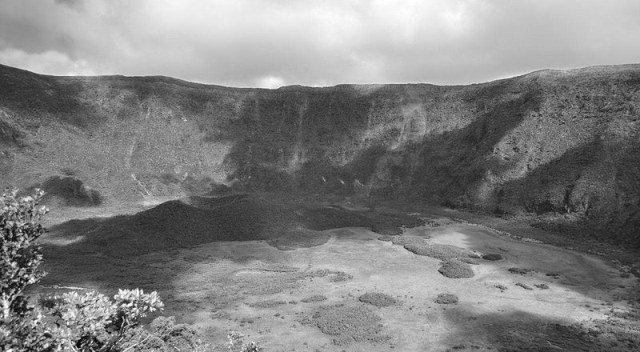
The path skirted an immense caldera in the center of the island. Green cliffs sloped down to swampy ponds at the bottom, and a ridge rose higher on the far side.
The Andinos had always lived near the caldera. According to her father, the family descended from Faial’s first inhabitant, a world-weary hermit who retreated to one of the most desolate spots on the tiny island.
In the distance, the symmetrical cone of Mount Pico rose above a neighboring island. Would it be a better place to live? If she had a choice, she would go to the big island of São Miguel. Fia kicked a stone. She had no choice.
Halfway down the mountain, a woman stood in the middle of the path, gazing at the town below. She was dressed shabbily in a stained and ripped skirt and loose blouse, and she wore neither shoes nor a hat. White hair was tied in a messy bun.
She turned and couldn’t take her eyes off Theo. “What a lovely goat,” she murmured.
“He is,” Fia agreed, “but I must take him to Horta to sell.” Her stomach sunk at the idea.
“I could use a goat,” the old woman said, a little too quickly. “What are you asking for it?”
Fia hesitated. “I’m to get the best price I can,” she said, remembering her mother’s words.
The old woman reached into a pocket of her skirt and pulled out a coin. It glittered in the sunlight. “I could give you this,” she said. “It’s worth far more than any other coin on this island, far more than a mere goat, but right now I need a goat more than I need a coin.”
Fia had never seen such a beautiful object. Larger than most coins, it shone a dark yellow and had an intricately shaped horse on one side, a female head on the other.
“Is it really worth more than all other coins?”
“It is.”
Captivated, Fia made the trade. She never stopped to wonder why a woman so impoverished would have an item of such wealth.
María did. When Fia got home with only the coin to show for her trade, her mother raved, tossed the coin into the water trough, and beat Fia mercilessly.
If it weren’t for the generosity of parishioners at the local Catholic church, the Andinos would have starved that winter.
Faial Island, 1850
The Andino mansion, set on a hill adjacent to Horta, was the most sumptuous house in all of Faial, an immense whitewashed building with dark stone trim, patterned walkways, and landscaped grounds. The Andinos owned a vineyard, a large herd of cattle, and several trade ships. They hosted lavish parties, and their children married into the upper crust of Lisbon society.
According to local lore, the Andinos once lived in a neglected shack near the caldera. When the matriarch of the family, Fia Andino , needed money one particularly difficult year, she remembered a coin she had received as a child. She put it up for sale. The coin, as it turned out, dated back to ancient Carthage and sold for a princely sum, reversing the family’s fortunes.
[photo of Faial Caldeira, JardimBotanico]