Author’s note: To get the most out of this story, I recommend you first read the previous blog about the place. Thanks!
Author’s note: This story is historical fiction. Though reworked, most of it is true, thanks to information found at the Crater Lake Institute, Mail Tribune, Oregon Encyclopedia, and Wikipedia.
Many people know of William Gladstone Steel as the man who spent seventeen years cajoling the powers-that-be into designating Crater Lake as a National Park. Some know he came from a family of abolitionists active in the Underground Railroad. Few know that Will was a dreamer and a mystic, and that his life was shaped by the occasional haunting magical moment.
When a schoolboy in Kansas, Will first learned of Crater Lake. Unwrapping the newspaper that contained his lunch, his gaze fell upon an article about an explorer’s discovery of a caldera-rimmed lake in Oregon. The explorer waxed euphoric over the deep-blue color of the water. Such a random encounter—if his mother had wrapped the lunch differently, the boy may never have seen the article. He vowed to visit the lake one day.
As chance would have it, in 1872 the Steel family moved to Portland, Oregon, where Will completed high school. Several years after his father died, he had a dream. In it, he and his father were wandering the narrow streets of an ancient city. “Will, do you wish to see something beautiful?” his father asked, then pointed upward, to golden arrows piercing the sky. “This is Cleetwood,” his father said, just before Will woke up. Though the word meant nothing to him, it conjured up a lovely memory, and he kept ‘Cleetwood’ close to his heart.
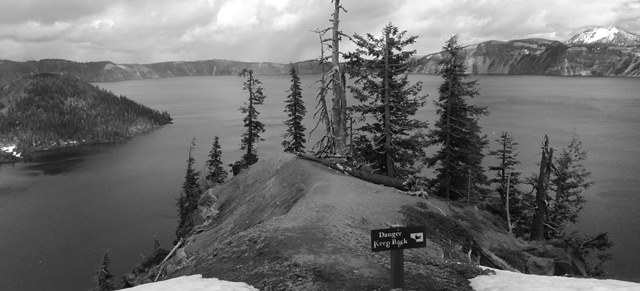
When Will finally reached the lake, in 1885, the gemlike deep blue water dazzled him. He longed to row across it but had no boat. The following year he joined Captain Clarence Dutton’s geological expedition to Crater Lake. His job—to provide wooden boats and depth-sounding gear. The largest boat he christened the Cleetwood. In mid-July, the expedition arrived at the rim of the lake. With great effort, several mishaps, and a near catastrophe or two, they lowered the boats down some eight hundred feet of a steep volcanic slope made more treacherous by fine-grained pumice. It took fifteen men eight hours to lower the twenty-six-foot-long Cleetwood, encased in a crate and set atop a sled. Their embarkation site was a small cove that would later bear the boat’s name.
The expedition remained for three weeks, examining the caldera and the lake and measuring its astounding depth. Will longed to have time alone on the lake. One night, when the moon was full, he stole away from camp and took a boat across the water. Later, he would write, “There was not a breath of air stirring and reflections were as perfect as it could have been in a plate-glass mirror. The walls were clearly outlined above the water and below were inverted, but just as clear. Upon yonder a full moon floated in the air and down below it was just as clear and beautiful. … I was an atom in the center of an enormous sphere, looking up to the starry heavens and looking down at its counterpart. The shoreline and its reflection appeared as a great knothole, with creation above, the creation below. … God in His infinite mercy permitted me to look out upon His glorious works as never man did before.”
At the end of their scientific work, the men agreed they could not get the boats back up to the rim, nor could they leave them to be vandalized or misused. So they scuttled them to the bottom of the lake, two thousand feet below.
Will dreamed the boats would lie there until Congress made the lake a national park. “Then,” he proclaimed, “the resurrection trumpet will sound, and the Cleetwood will awake. So must it be!”