Author’s note: To get the most out of this story, I recommend you first read the previous blog about the place. Thanks!
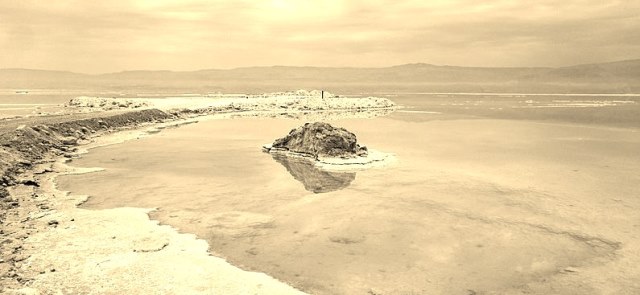
The Jordan River Valley around the Dead Sea provides the setting for one the more curious Biblical stories, that of Lot and his wife’s transformation into a pillar of salt (Genesis, chapters 11-14, 18-19).
The story begins when Lot’s father dies, and the young man joins his uncle, Abram, later known as Abraham, and Abraham’s wife Sarah on a journey. God has called on Abraham to leave his country and settle in Canaan (the region of today’s Israel), where he will make Abraham’s people into a great nation. They reach Canaan and establish a settlement.
Here we have a puzzling footnote in our story. A famine soon ravages the region, and the three leave for Egypt. There, Abraham pretends Sarah is his sister. He reasons thus: Sarah is beautiful and, if the pharaoh sees her, he will kill Abraham and take Sarah as his wife, and Abraham needs to live. Well, the pharaoh does take Sarah as his wife, but God causes a series of plagues to befall Egypt. Abraham confesses the truth, and he, Lot, and Sarah are thrown out of Egypt—curiously, with all their possessions.
After this, Lot and Abraham return to the area of Canaan where they had settled earlier. However, because the land cannot support both men’s vast flocks and herds of livestock and the herdsman are beginning to quarrel, they decide to separate. Lot heads east to the rich plains of Jordan, pitching his tents near the town of Sodom.
Not a good idea. The people of Sodom are known to be wicked, morally corrupt sinners against God. At one point, Abraham has to rescue Lot when he is kidnapped by several kings. Yet even after that, Lot remains in Sodom, preferring urban pleasures to the nomadic God-fearing life Abraham has chosen. He grows attached to the city, in spite of (or perhaps because of) its wayward ways. When God tells Abraham of his plans to investigate the evil in Sodom and Gomorrah for himself, Abraham, ever the devoted uncle, pleads with God to save the righteous in the city.
As God’s emissaries, two angels enter Lot’s house. Unruly mobs of men outside demand to have carnal relations with them (thus, the origin of the word ‘sodomy’). Instilled with a residue of fear of the Lord, Lot pleads with the mobs to take his two virgin daughters instead—sheesh! However, before the men can act, the angels blind them. This incident does seem to be the proverbial last straw for God. The angels tell Lot and his family to leave the city, for it will be destroyed. Lot tries to convince his future sons-in-law to leave, too, but they think he is joking and remain. Even Lot himself hesitates, and the angels must grasp the hands of Lot, his wife, and his daughters to get them to move. “Flee for your lives,” the angels warn them outside the city, “and don’t look back.”
God’s fire and brimstone rain down on Sodom and Gomorrah. As Lot flees, his wife, who never gets a name in the Biblical account, does indeed look back, perhaps in sorrow, or merely curiosity, and she is turned into a pillar of salt.
The story doesn’t end there. After the destruction of the cities, Lot, now an old man, and his daughters flee to the mountains and live in a cave, isolated from other people. The daughters, intent on preserving the family line and realizing there are no other men around, ply Lot with wine. When he is in a drunken daze, they have sex with him without his knowledge. Okaaay… Both have sons, who go on to establish nations that alternately battle and tempt future Israelites.
All of this begs the question: Was his nephew Abraham’s ‘lot’ in life?